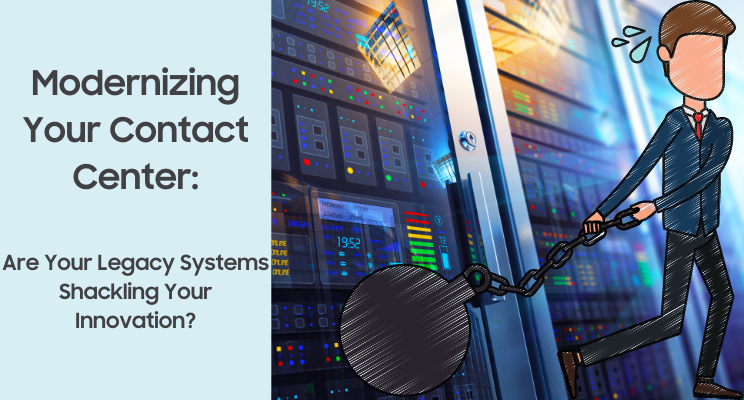
Are you still running an on-premise contact center? Have you looked at cloud contact centers but thought they were too expensive? If you answered “yes” to either of these questions, this blog is for you. I completely understand your point of view. When I was a buyer, I looked at cloud three times before fully understanding the entire value proposition of cloud contact centers. In this blog, we will discuss the value proposition for cloud contact centers and how you can build a compelling business case to move to the cloud.
Why do the benefits of cloud sometimes not make sense on first (or second) glance?
When I first looked at cloud, I took a very tactical approach to the value assessment. I looked at all the technology that currently supported my contact center – telco costs, maintenance costs for the PBX, ACD platform, WFM, Call recording/QM platforms, and the 5 year estimated software/hardware upgrade costs. I then compared it to the annual costs of licenses and support in the cloud. I’m sure you probably can predict the outcome of the comparison – the financials for the migration didn’t make sense. Cloud appeared to be too expensive.
After I transitioned to a contact center operations role, I started understanding the bigger picture. I learned about customer journey mapping, customer effort scores, started looking at the voice of the customer and employee survey results. As I learned more about cloud, I learned that cloud is not about replicating your legacy processes. It is about enabling transformation & innovation. It enables you to build an ecosystem of integrated applications that provide a better total experience (UX + CX + EX) which enable better business outcomes. When exploring how cloud could enable this transformation, I got clarity on the true value proposition. The technology savings were a small part of the overall benefits. The larger benefits included increased revenue, reduced costs, improved customer experience and improved agent productivity. When I started to look at the move to cloud as a business transformation rather than a tactical “lift and shift” project, the benefits became very clear.
Where do you start? Steps to Transform Your CX & EX
- Don’t start with technology, start with your customer journey. It may seem odd that I would suggest the experience as the starting place. After all, I work for a technology company. However, you have to understand where there is friction & pain so that you can correct the issue. Look at the journey from several different customer personas to understand if there are different pain points based on persona. Understand the employee experience when assisting the customer – are there pain points that should be addressed?
- Design the desired customer journey should be and perform a gap analysis. As you are creating the desired customer journey, think about trends in overall customer experience. Customers want a personalized experience. They want effortless experiences in the channel of their choice. They want to self-serve but also easily talk to a person when necessary. What is preventing you from achieving the desired customer journey today? It could be processes, systems or both.
- Document the business outcomes for these desired customer journeys as a basis for your business case. Once you have the desired customer journey, you should outline the expected results of these journeys. This is the basis of your business case. For instance, did you identify friction in your customer journey because you don’t have proactive notifications? If so, benefits for adding proactive notifications could include reduced operational costs by proactively deflecting contacts, a higher net promoter score due to an improved customer experience and a reduced number of cancelled orders due to transparency in the process.
- Baseline your current operations. In order to quantify the results of the desired business outcomes, you will need to baseline your current operations. The more data you can gather on the current state will help you quantify results after the transformation. This should include operational KPIs – average handle time, ratio of contacts to orders (or other metrics depending on your vertical), NPS/CSAT/CES score, employee experience score, agent attrition rate, customer churn rate, training costs, occupancy rate, first contact resolution, etc.
- Understand industry benchmarks in a modernized contact center. Gather benchmark data for cloud contact center – what are typical results for a customer engagement transformation? What is the gap between your contact center’s current performance and the benchmark data? This will help you identify targets for your transformed state.
- Determine system of record for the desired future state. As I was designing the desired future state, I realized that there were overlaps in functionality across systems. One of the key areas to think about for future state design is the system of record. For instance, chat could be managed in your CRM, stand-alone digital platform or your contact center platform. For me, having blended agents that were able to handle all channels and increasing agent occupancy was critical in my business case. Being able to report on all contact types with a common reporting engine was also important. Therefore, I chose the contact center platform to be my source of record to handle all contact types, ensuring that the routing engine could effectively manage the distribution of contacts and drive higher occupancy. I then integrated the contact center platform with the CRM to write the contact history to the customer record in the CRM.
- Select the cloud platforms to support your desired business outcomes and identify integrations needed to create a customer-focused ecosystem. Once you have determined systems of record, you are ready to start selecting your cloud platforms that will support your desired business outcomes. Understanding pricing nuances and how the systems interact will help you make decisions on your future state vendor selections. For me, having the contact center & UC platform integrated was critical to driving out additional costs and achieving additional efficiencies. RingCentral’s solution enabled me to leverage the best-in-class UCaaS and CCaaS platforms and drive out additional telephony costs in the operation.
- Formalize your business case. Formalize your business case – building the benefits and costs for the lifetime of the contract. For me, I took an iterative approach to the implementation, focused on core capabilities first. Then, I outlined phases or sprints to get to the desired phase. Understanding the timeline for this will enable you to accurately forecast technical and operational savings.
- Implement & continue to innovate. Once you have the cloud ecosystem implemented, you will no longer be shackled by your legacy systems. You will no longer be focused on end of support, upgrades, hardware refreshes, etc. You will be focused on continuing to improve the experience – where did you meet or exceed expectations? Where should you focus on to improve the journey? Even after you get to the planned ideal state, you will continue to identify areas to improve and evolve.
What are Typical Results for this Type of Transformation?
The majority of the value for a contact center transformation is not technology savings. I work with companies on their business cases for contact center transformations. On average, the technology savings make up 20-40% of the total value of these transformations. The remaining value is in the operational benefits which typically include lower agent attrition, higher agent productivity, decreased contacts due to automation and reduction in customer friction, higher occupancy, and increased revenue. The ideal customer experience can’t be provided with a contact center platform alone, but by creating an integrated ecosystem with the contact center and the other CRM and back office systems which could include ERP, EMR, ticketing systems, and many other applications.
RingCentral recently released results from their customer survey on business results from UC/CC transformations. The results included, on average, an ROI of 47%, payback in 11 months, and an increase in CSAT of 47%. In addition, Nemertes also released a study in 2020 on typical outcomes of a customer engagement transformation. For large companies (more than 2500 employees), typical outcomes included increased revenue of $815 million, cost reductions of $5.5 million, improved CSAT by 39% and improved agent productivity of 37%. The benefits of cloud are significant not just for the near term, but also the long term focus continuous improvement and innovation.


Leave a Reply