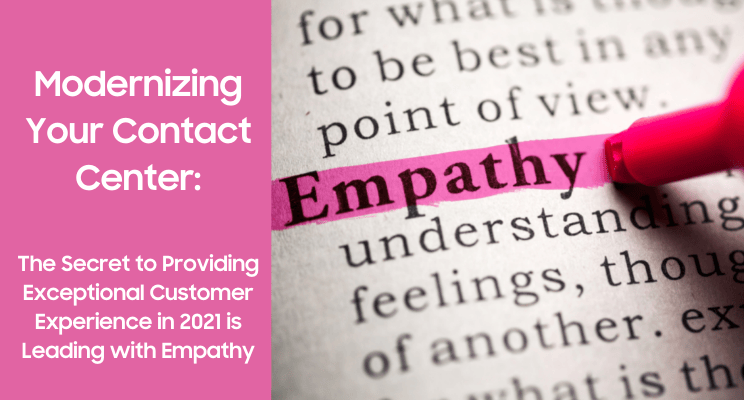
Empathy is the ability to understand and share the feelings of others. The pandemic has impacted all of us. However, our experiences are different. Our preferences are different. We continue to see a “one size fits all” approach failing to fit the needs of most. The golden rule, “treating others the way that we want to be treated” lacks empathy. The platinum rule, “Treat others the way that they want to be treated” is now the imperative. In fact, leading with empathy is critical to drive better employee and customer experience.
Leading with Empathy – The Employee Experience
Let’s start with employee experience – why is empathy so important? First, there is a direct link between happy employees provide better customer experiences. There isn’t a one-size fits all when it comes to providing a great employee experience. Gallup found that 48% of employees are actively looking for a new job. Adobe released a new study stating that over half of Gen Z workers are planning on pursuing a new job this next year – only 56% are satisfied with work/life balance and 59% are satisfied with their job overall. This is being referred to as the Great Resignation. Additional findings from the study included too much time is being spent on unimportant tasks and technology is falling short as an enabler to being more productive. Between April – June, there were 11.5 million people who resigned, which accounts for over 7% of the workforce in America.
The high rate of turnover is concerning. As more people resign, it takes time to recruit and onboard that employee’s backfill. Employees will continue to be stretched thin. This could result in others feeling that there is a lack of empathy and more feelings of burnout – perpetuating this cycle. This cycle negatively impacts your customer experience. What can we do to prevent or reduce this ongoing cycle of burnout and resignation? Personalizing the employee experience is key.
Steps to Providing a Personalized Employee Experience
- Listen to your employees and provide multiple methods for feedback. This includes having regular one on ones with employees where they are able to bring up any concerns they have. This also includes anonymous employee surveys and employee roundtables. Enabling your employees to have a voice and show employees you are listening to them is critical to proving an empathetic employee experience.
- Provide effective technology that includes collaboration tools & automation. One of the major contributors to employee burnout was administrative tasks. Look at ways the company can minimize administrative tasks and automate processes. Collaboration tools also enable more effective communication between teammates that can drive efficiencies and minimize administrative tasks. Providing a digital-first environment can be a key differentiator for your company to attract & retain talent. You can read more about ways to create a better digital experience through a recent blog I wrote.
- Provide flexibility. Flexibility includes working hours and also where to work. Millennials and Gen Z are more likely to switch jobs looking for flexible work schedules and having the options to work from anywhere. For scheduling, contact center needs sometimes drive additional rigidity based on contact volumes. However, providing your staff with the capability to shift-bid and provide their feedback to schedules may provide some opportunities for more creative scheduling – whether it is split shifts for those that may have mid-day commitments are self-scheduling based on forecasted volumes.
Leading with Empathy – The Customer Experience
Just as employees are leaving their companies, customers are also leaving brands that do not live up to their expectations. Freshworks released a new study that stated that 52% of customers stopped doing business with a company during the pandemic due to wait times being too long, insensitive communications, a competitor responded to the pandemic more effectively or they couldn’t get a response to their inquiry. In fact, 80% of consumers want quicker responses from companies. In addition, 63% of consumers expect brands to consider their personal values when communicating with them. Personalization is also the key to providing a great customer experience. 77% of consumers are willing to exchange personal data for a better experience.
Steps to Providing a Personalized Customer Experience
- Provide self-service as an option, don’t force it. Some consumers prefer to self-serve and others would prefer to speak to a human. While self-service enhances operational efficiencies, it can also increase customer churn if customers feel like they can’t reach a helpful person to assist them with their inquiries.
- Provide multi-channel self-service. As you look at your self-service strategy, ensure that you are offering self-service across all channels. As customer behaviors have moved to digital over the course of the last 18 months, it is critical that you assess your digital self-service options including offering a variety. Things to consider include providing an effective customer-facing knowledgebase, offering communities, social media engagement and bots.
- Assess the customer journey and eliminate friction. Where in the customer journey are you receiving the majority of your contacts? Identify ways to eliminate that friction so that it is easier for the customer to do business with you.
- Provide multiple channels for the customer to reach out to you. Provide multiple channels – both digital and phone – that your customer can reach out and ask questions. Use data and automation to authenticate the caller and be able to personalize the experience once presented to an agent.
- Provide proactive alerts. Proactive alerts not only provide a better customer experience, they help drive revenue. Whether it is appointment reminders or notification of order status, providing information to the customer and reminders will ensure a better customer experience with a lower level of effort.
The Best Experiences Start with Empathy
Leading with empathy will providing a better employee & customer experience. Personalizing the experience for the employee and customer will reduce churn and ultimately drive more revenue. Are you ready to start assessing where you can provide better experiences?