Tag: Customer Experience

  • The Connected Experience: Creating Experiences People Want to Come Back For

    The Connected Experience: Creating Experiences People Want to Come Back For

    Twenty-two years ago, I had absolutely no idea how to cook a turkey, much less prepare an entire Thanksgiving dinner.

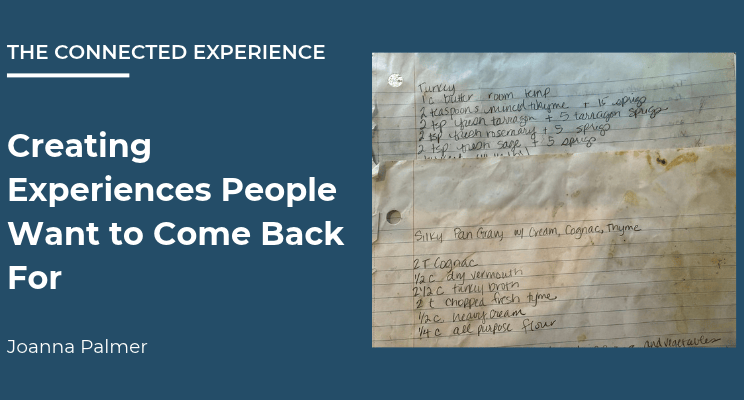
    I had an insert from the Kansas City Star that included holiday recipes. I used those recipes to learn how to make a turkey and gravy, and to this day, I still use those same recipes. The handwritten recipes are stained and tattered, but they remain the foundation of our Thanksgiving meal.

    When I decided to start hosting, my oldest daughter was almost 2 years old, and I wanted to create positive, lasting memories for her. I remember going to my parents’ house for Thanksgiving and how noticeably stressed my mom would be preparing a large meal for our extended family.  I wanted to remove that stress for her and create lasting positive memories for future Thanksgivings.

    For me, preparing a large family dinner is something I genuinely enjoy. I find it relaxing, and I wanted to create an experience where everyone could come together, enjoy great food, have fun and make memories.

    My oldest daughter is now 23, and my family lovingly refer to Thanksgiving as “our Super Bowl.” It has become a day that both family and friends look forward to every year. As the kids have gotten older, they have started bringing their significant others and friends. Everyone knows they are welcome, and regardless of how many people show up, there will be plenty of food.

    Thanksgiving is my favorite holiday. It’s about connections, relationships and creating an experience that people want to come back for.

    And isn’t that ultimately what we are trying to accomplish with customer experience?

    Start With the Experience You Want to Create

    When I started hosting Thanksgiving, my objective wasn’t simply to serve dinner. If that had been the goal, there certainly would have been easier and more efficient ways to accomplish it.

    My objective was to create an experience.

    There is an important distinction between the two, and I think it’s one that organizations sometimes lose sight of as they embark on customer experience and AI transformation initiatives.

    We spend a tremendous amount of time discussing how many interactions we can automate, how we can reduce our cost to serve, how we can improve employee productivity and how we can increase self-service containment.

    These are all legitimate business objectives. Organizations need to operate efficiently, and AI presents significant opportunities to accomplish this.

    But what if we started with a different set of questions?

    • What do we want our customers to experience?
    • What do our customers already value about doing business with us?
    • What could we do to make their lives easier?
    • What would make them choose to do business with us again?
    • What experiences are we not delivering today that AI could make possible?

    The answers to these questions might fundamentally change how we approach our AI investments, prioritize use cases and measure success.

    Preserve What’s Working

    Over the years, my Thanksgiving menu has evolved. I’ve discovered new recipes on Pinterest, incorporated a green bean casserole recipe from a Campbell’s soup cookbook and added to the meal as our family has grown.

    But those original turkey and gravy recipes? They aren’t going anywhere.

    There are undoubtedly thousands of turkey recipes available online today. I could ask AI to recommend a new recipe, identify a more efficient cooking method or suggest an entirely different approach to preparing Thanksgiving dinner.

    But why would I change something that works so well and has become part of what people look forward to every year?

    I don’t need to reinvent the entire meal to make the experience better.  There is a similar lesson for organizations embarking on transformation.

    When we introduce new technology, particularly something as transformative as AI, there can be a tendency to focus on what we can replace rather than what we should preserve.

    Before redesigning a customer journey, automating an interaction or changing an established process, we should understand what is working well today and why.

    Perhaps it’s the expertise of a tenured employee who knows how to navigate complex customer situations. Perhaps it’s a personal interaction that differentiates your organization from its competitors. Perhaps it’s a process that, while not particularly sophisticated from a technology perspective, consistently delivers an exceptional customer outcome.

    These are assets that should inform your transformation strategy, not become unintended casualties of it.

    This is where AI can play a particularly interesting role. We can use conversational intelligence to understand not only where customer interactions are going wrong, but also what is happening when they go exceptionally well.

    What are our most successful employees doing differently? What experiences are customers responding positively to? How can we make those experiences available to more customers?

    Sometimes the greatest opportunity for transformation isn’t creating something entirely new. It’s taking what we already do exceptionally well and finding ways to deliver it more consistently and at scale.

    Transformation doesn’t require us to abandon what works. It gives us an opportunity to build upon it.

    Anticipating Needs Rather Than Simply Responding to Them

    One of the things our friends and family know about Thanksgiving at our house is that there will always be enough food. They don’t need to worry about whether there is room for another person or whether bringing a friend will create an inconvenience. Everyone is welcome.

    As organizations, how often do we design experiences around anticipating our customers’ needs rather than simply responding to them?

    A customer whose flight has been canceled shouldn’t necessarily have to contact an airline to understand their options for getting home.

    A hotel guest traveling with their family may have very different needs than that same guest traveling for business, even though their customer profile hasn’t changed.

    A customer purchasing a new piece of technology may benefit from proactive guidance on setup and installation rather than having to contact technical support when something goes wrong.

    AI gives us an opportunity to better understand context, anticipate needs and deliver experiences that historically would have been difficult or expensive to provide at scale.

    Yet much of the conversation around AI remains focused on handling the interactions we already have, rather than reimagining the experiences we could create.

    There is a significant opportunity in that distinction.

    Consistency Doesn’t Mean Everything Has to Stay the Same

    Our Thanksgiving gatherings look very different today than they did 22 years ago. The kids have grown up, new people have joined us, and the dynamics of the day have changed.

    The experience has evolved alongside the people who participate in it.

    But there are certain things everyone has come to expect. They know they will be welcomed, there will be great food, and it will be a day filled with family, friends and fun.

    That consistency is part of what makes the tradition special.

    The same is true in customer experience.

    Customers develop expectations based on their previous interactions with an organization. When those expectations are consistently met, trust grows.

    But consistency doesn’t mean delivering the exact same experience to every customer or expecting customers to have the same needs they had five years ago.

    One of the most compelling opportunities with AI is its ability to help organizations deliver greater consistency while adapting to the individual needs and circumstances of their customers.

    Imagine employees having access to the right information at the right time, regardless of their tenure. Imagine customers being able to move between digital and human-assisted channels without having to start their conversation over. Imagine an organization understanding the context of a customer’s needs rather than treating every interaction as an isolated transaction.

    These capabilities are about much more than operational efficiency. They are about creating confidence in the experience a customer can expect from your organization while allowing that experience to evolve.

    Efficiency Should Enable a Better Experience

    If my primary objective for Thanksgiving were to minimize the amount of time I spend preparing dinner, reduce the cost per person and eliminate unnecessary activities, I could certainly redesign the day.

    I could simplify the menu, limit the number of guests and shorten the gathering.

    By those measures, Thanksgiving might become considerably more efficient.

    But would it still be our Super Bowl?

    Definitely not.  Imagine if I served canned gravy instead of the homemade gravy that people talk about year round!  There would be a revolt!

    That doesn’t mean I shouldn’t look for ways to make preparation easier. If something allows me to spend less time on a repetitive task and more time enjoying the day with family and friends, that’s a win.  I have started preparing more of the food in advance so things are not so frantic in the kitchen when guests arrive.

    The important thing is that efficiency serves the experience rather than becoming the experience.

    What if, in addition to reducing operational costs, we used AI to:

    • Give employees more time to focus on complex customer needs and meaningful conversations.
    • Provide personalized experiences that previously weren’t economically feasible.
    • Identify recurring customer frustrations and address their root causes.
    • Create proactive experiences that eliminate the need for customers to seek assistance.
    • Uncover unmet customer needs and opportunities to deliver additional value.

    There is a difference between using AI to do what we do today at a lower cost and using AI to create something better than what exists today.

    Organizations should be exploring both.

    Are We Measuring What Really Matters?

    I don’t measure the success of Thanksgiving by how quickly everyone eats, how much food is consumed per person or how efficiently I clean the kitchen.

    I measure it by the experience people have.

    Did everyone feel welcome? Did they enjoy themselves? Did we create new memories? Are they looking forward to coming back next year?

    As organizations invest in AI, we need to be equally thoughtful about how we define success.

    A reduction in average handle time doesn’t necessarily mean a customer had a better experience. An increase in containment doesn’t necessarily mean a customer’s issue was resolved. A reduction in contact volume doesn’t necessarily mean customers are happier.

    We need to connect operational improvements to meaningful customer and business outcomes.

    Are customers making less effort to accomplish what they need? Are we resolving issues more effectively? Are we strengthening customer relationships? Are customers choosing to stay with us, purchase more from us and recommend us to others?

    And just as importantly, are we preserving the things that made our customers choose us in the first place?

    These are the outcomes that help us understand whether we are truly transforming the customer experience.

    Creating Experiences Worth Coming Back For

    This week, I’ll once again pull out those stained and tattered turkey and gravy recipes. I’ll reference some recipes on Pinterest and pull out others from cookbooks I’ve had for years.

    Some of what I’ll prepare is exactly what I prepared two decades ago. Other things have been added along the way.

    It’s a combination of the old and the new, each contributing something to the overall experience.

    I think that’s a useful way to think about transformation.

    As you evaluate your organization’s AI transformation strategy, consider four questions:

    • What experiences are worth preserving?
    • Where are there opportunities to make those experiences even better?
    • What new experiences can we create that weren’t possible before?
    • How will we know whether we’ve made a meaningful difference for our customers?

    The goal shouldn’t simply be to create a more efficient version of the experience we deliver today. It should be to create an experience our customers want to come back for.

    Technology will continue to evolve. Customer expectations will change. New capabilities will emerge that we haven’t even considered yet.

    Not everything needs to change. Sometimes, the foundation of a great experience is already there. We just need to recognize it, protect it and build upon it.

    This Thanksgiving, I’m grateful for the connections, relationships and memories that have been created around our table over the years, and for the opportunity to continue creating them.

    Happy Thanksgiving!

  • Best Practices for Quality Management in the Contact Center

    Best Practices for Quality Management in the Contact Center

    It’s 2021. It’s been tough to attract and retain talent. It is more critical than ever to ensure that you have a quality program in place. Whether you are onboarding new agents or ensuring that tenured agents are providing the best level of service, quality is important.

    Creating Scorecards – What Makes a Great Interaction?

    The first step in quality management is creating a score card. This is a tool that can be leveraged to provide consistent and standard feedback to agents when reviewing a contact. What makes a great scorecard? You need to determine what is important in the interactions. What drives customer satisfaction and first contact resolution? Things to think about here are the following behaviors:

    • Soft-skills: What soft skills should the agent display when speaking with customers? Were they empathetic, friendly? Did they show the proper emotion for the situation?
    • Process: Did they follow the correct process for the question or inquiry that the customer was asking about. Also, when thinking about various different channels, you may want agents to used canned responses or quick replies for digital contacts to preserve time. You want to ensure that agents are not asking customers to repeat themselves if the customer provided the information in the IVR.
    • Security & Compliance: Did the agent follow all security and compliance requirements. Did they authenticate the caller if needed. Did they remain PCI compliant?
    • First Contact Resolution: Did the agent own the issue and correctly answer the customer’s question? Did they offer additional assistance to prevent additional contacts?

    Determining Frequency of Feedback

    After you have the scorecards created, you have to determine how often you will be providing feedback and coaching sessions to the agents. How many Evaluations will you perform for each agent in a set period of time. When using quality platforms, you can create plans that help you complete this for each agent. With more advanced quality management platforms, you can filter the contacts that are fed into the plans based on attributes such as sentiment, categories, duration of calls and even keywords.

    As you think about how many contacts to evaluate per agent, a one-size approach may not make sense. For example if an agent handles multiple channels, you may want to consider a minimum number of evaluations per channel. This will enable you to ensure that the agent is providing a consistent great experience across multiple channels. A new agent or an agent that may not performing to standards should have more evaluations done with an agent performing to standard. This will ensure that you provide more coaching to those that need more development. Sometimes I have seen agents that are performing to a certain level getting a minimum number of evaluations each month whereas those that are under the threshold get feedback on a daily or weekly basis.

    Coaching Sessions

    Determine how often you provide coaching sessions to agents. Ensure that they are getting feedback on a regular basis. In addition, you may want to provide an agent the opportunity to self-evaluate prior to the session. This will provide a great opportunity for the agent to identify areas of improvement and areas they excelled at as well as provide a basis of conversation during the coaching session. Provide a mechanism fort the agent to be able to contest their score if they don’t agree with the score. This will provide an opportunity for someone else to evaluate the contact and either uphold the evaluation or change the evaluation based on re-reviewing. Having consistent coaching sessions will enhance the employee experience which ultimately will help with retention and customer experience.

    Calibration Sessions

    Calibration sessions are critical to ensure that the quality program is accomplishing its goals and there is consistent scoring. This is where multiple stakeholders (agents, supervisors, managers, business stakeholders) come together and listen to or look at the same contact. This ensures consistency in scoring. If there are inconsistencies or disagreements on how to score a contact, they can be discussed during the calibration session and procedures may need to be updated. This also builds awareness on ratings and also highlights if there are changes needed to the scorecard. With some of the nuances in scorecards associated with weighting, oftentimes those nuances are highlighted either in the review of contested scorecards or calibration sessions. Calibration sessions should be held at least once per month.

    Use Data to Track Impact

    As you start your quality monitoring program, you will want to track the quality of calls over time. Things to track include the impact of the quality program on employee satisfaction scores. Employees should become happier by having meaningful coaching sessions on a frequent and regular basis. This should also result in higher employee retention. Your agent tenure should also go up due to agent retention increasing. Customers should be happier with getting better service. This should be reflected in customer satisfaction scores. First contact resolution should also be higher.

  • How to Prevent Contacts Before They Get to Customer Service

    How to Prevent Contacts Before They Get to Customer Service

    I often get asked what an ideal contact center looks like. I used to answer “An ideal contact center would be one where there wasn’t any contacts…at all.” However, I have shifted in my thinking. Sometimes, you want customers to contact you in order to build or deepen the relationship. It doesn’t always need to be over the phone, it could be across a number of different channels. However, customers should have the opportunity to self-serve through multiple different channels. Oftentimes, the contact center addresses friction in the customer experience. While, it isn’t realistic to think that we will get to no customer service contacts, there are steps you can take to reduce the number of contacts coming into your customer service organization while maintaining or improving customer satisfaction.

    Strategy #1: Have a robust customer facing knowledge-base/self-service portal

    88% of customers expect a company to have an online self-service portal. In fact, 65% of customers prefer self-service for simple inquiries. A robust knowledgebase is critical as part of your self-service strategy. Some of the critical capabilities that I looked for when I managed the knowledge and self-service aspects in the contact center included:

    1. Knowledge Search – Having intelligent, contextual search engines that were included federation. Making the knowledge readily available and easy to find is critical.
    2. Knowledge Creation – Having a simple interface to be able to create content. Version control and the capability to support multiple media types including videos and pictures was critical.
    3. Have troubleshooting flows – Having decision trees in the knowledge bases enable customers to troubleshoot .
    4. Robust analytics & reporting – Gain insights on the number of people leveraging the knowledge articles. Understand what the next step was after they consumed the content. This will enable you to understand whether the article was helpful. In addition, providing the customer with an opportunity to rate knowledge articles is also insightful.

    Strategy #2: Provide Self-Service across your contact center channels

    I was surprised with some of the latest cost per contact data from Benchmark Portal this year. For the first time since I started looking at the data, the cost per chat was more expensive than the cost per voice call. This was very surprising, but it got me thinking. How many companies are deploying web chat without a self-service strategy? We have mastered self-service in the IVR. There are many benefits of webchat including the asynchronous manner and the capability for agents to handle more than one chat at a time. However, deploying chat without a self-service strategy such as a bot can be detrimental to the success of your channel strategy. Bots (preferably conversational AI bots) should be deployed across your digital channels to help with your self-service and deflection strategy.

    Strategy #3: Leverage Analytics to Understand the Reasons for Contact and Reduce Customer Friction

    Interaction analytics is one of my favorite contact center tools. However, it is not just for contact center staff. This tool takes a plethora of unstructured data and converts it to structured, actionable data. Leveraging the data you get from interaction analytics to identify customer friction across the customer lifecycle is critical to driving out friction and ultimately reducing customer service contacts. I would encourage contact center managers to architect their analytics to enable transparency across the organization. Ideally other divisions could leverage analytics to understand how to improve their areas whether it is product, marketing, sales, supply chain, etc to reduce friction and eliminate contacts.

    These are just three areas to focus on to increase self service and decrease contacts coming into your contact center. I would encourage you to look at reporting on each of these areas and continue to focus on contact deflection as one of the key areas in your contact center. I had a group that focused on this and were measured by the percentage of contacts deflected. What other ways are you deflecting or preventing contacts from coming into your customer service organization?

  • Should Customer Performance Indicators (CPIs) be the New KPIs?

    Should Customer Performance Indicators (CPIs) be the New KPIs?

    When we think about key performance indicators in the contact center, I am starting to think we have it all wrong. We talk about the maturation of the contact center – moving from a call center to a contact center to a customer experience center. While we have reimagined the customer experience in the call center, it is time to reimagine the metrics that come along with reporting. Should customer performance indicators (CPIs) be the new performance standards for the customer experience center?

    The Birth of the Call Center

    When I started my career, call centers were considered a necessary part of every business where customers could call in and ask for help on their specific inquiry. The IVR was often an auto-attendant – redirecting the call to a specific department. As the call center matured, so did the IVR. There began to be a focus around self-service and deflection – getting information from back-end systems to provide to the caller. Then customers began to email the call center. A call center was no longer just a call center, but rather was beginning to become a contact center. We weren’t thinking about queuing anything more than just calls, but were starting to think about how we organized groups to handle calls vs. emails. Typically we had a phone group and an offline group handling emails and manual orders.

    From Call Center to Contact Center

    With the adoption of e-commerce, web chat started emerging as a new channel. Most often, phone was handled by one group and chat/email was handled by another group. When the smart phone emerged in the early 2000s – social media also started to be introduced. We quickly realized that social media wasn’t only for personal communication, but we needed to use it for business communications as well. Social Customer Care groups were created to address this need.

    Additional channels were introduced. We also started learning about the value of the relationship and a great experience in the contact center. When a customer had a poor customer experience with the company, they started using social media to tell their friends (and the rest of the world). We started shifting our thinking. We can’t afford to continue to look at average handle time as the primary KPI for agent performance in the contact center. Call centers needed to get less rigid about call scripts so that agents didn’t sound so robotic and well…scripted. Customers wanted to be able to interact with the agents and have a conversation.

    Over the course of the last decade, we have realized that we need to have a cohesive approach when it comes to responding to customer inquiries across all channels. Customers may start a conversation in one channel and move to another channel. The conversations need to be threaded across channels. We also realized the value of customer satisfaction. The agent had an impact on overall customer satisfaction which ultimately had an impact on revenue.

    From Contact Center to Customer Experience Center

    We now believe that the contact center is more than just an organization that reacts to customer inquiries. It can add overall value to the organization. It can even be considered an extension of marketing. The goal of the customer service organization is not only to reply to contacts, but to be proactive and customer focused. The contact center can enhance the relationship with the customer. Contact center management has stopped coaching agents on average handle time and adhering to strict scripts. Customer Service organizations are starting to be considered strategic partners in the organization. The data they have and the advanced applications enable better insights into the customer journey. The contact center can identify customer friction throughout the organization and show ways to reduce customer friction.

    Why Traditional Call Center KPIs Don’t Make Sense

    What are the top call center KPIs? The main ones are Abandon rate, average speed of answer, average handle time, transfer rates, average handle time, service level and first contact resolution. There are so many variables that go into each one of these KPIs. When I was working in a contact center, I had so many conversations on average handle time and the variables of the day, week or month that was driving AHT. It could be a new change on the website would drive more calls and drive higher AHT as the calls were more complex than usual. Minor variations into these KPIs typically did not impact overall customer satisfaction.

    What drove customer satisfaction? Quick resolution time, being able to get their question/issue handled and knowing that the agent cared. There are a whole new set of tools that we need to consider the impact to overall customer satisfaction and ultimately company profitability. AI infused routing to get the contact to the best matched agent, analytics to identify upstream friction (so that we can eliminate it), customer sentiment detection are all fairly new to the contact center.

    As the systems mature, why haven’t we rethought analytics and performance metrics more? More people are thinking about the contact center not as operational overhead, but rather an extension of marketing. Customers drive company growth. How? Through social media, company reviews, word of mouth and much more. KPIs are company centric whereas CPIs are customer centric.

    CPIs You Should Consider Measuring

    Customer Effort Score – Unlike NPS which is company focused, Customer Effort Score is customer focused. While companies want customers to promote them, customers want companies to be easy and frictionless. Therefore, companies should move to CES to be more customer centric.

    Customer Sentiment – Companies should measure the ratio of contacts with positive sentiment vs. negative sentiment. Companies should make it a goal to have a very high ratio of positive contacts to each negative contact.

    Customer Reviews – Companies should track organic customer reviews. How many positive reviews vs. negative reviews does a company get?

    Customer Acquisition & Customer Retention Rate – How many new customers are you acquiring and what is your customer retention rate?

    Time to fulfill the customer’s desired outcome – How is the company performing compared to the customer’s desired outcome. This may be mean time it takes to provide a quote or the mean time it takes to resolve an issue once reported. If they have already ordered a product, it is mean time to fulfill the order.

    With all the advances in technology, it is time to rethink the way you measure your performance as a customer centric company. Saying you are customer centric is just the first piece of adding additional value. You have to perform as a customer centric organization – flattening the organization and focusing on the customer outcomes. Then, you have to measure how you are doing based on customer expectations. It is time to update those performance indicators to reflect your more modern customer-centric organization.

  • Five Critical Steps for a Successful Digital Transformation

    Five Critical Steps for a Successful Digital Transformation

    According to McKinsey, 70% of digital transformations fail, typically due to lack of employee buy-in. Digital transformation has become a driver for contact center modernization. This is not just a lift and shift of current technology, but a complete transformation. It is creating an ecosystem of systems to provide more digital channels that result in a better customer experience. And those companies that succeed with digital transformation see an increase in customer satisfaction and increases in revenue. How do you ensure that digital transformation succeeds? It begins with culture.

    Defining the Customer Experience Vision

    The first step in any digital transformation is defining the vision. This vision typically comes from the c-suite, but should include inputs from other areas of the organization. It should address some of the pain points that are experienced today. What should great customer experience look like? How do you modernize the experience to meet customers needs? Removing friction from the current experience and enabling the customer to engage in the channel of their choice are critical. It should also include proactive communication.

    Start with Desired Business Outcomes

    Begin with desired business outcomes when defining the transformation. Starting with the legacy processes could limit your ability to innovate. The death of any great transformation is getting caught up with “this is the way we have always done it”. As you create new business processes, it will look very different than legacy processes. There will be those that doubt that the new processes will work. Listen to the feedback and identify areas of focus for change management,

    Focus on Change Management

    When I was leading transformation, I often went to the CIO/COO to emphasize the importance and criticality of change management. I found creating a change advocate group that spanned across all levels of employees worked well. We would have bi-weekly meetings with the group providing updates and listening to feedback. We would encourage the change advocate team to talk to their peers about the transformation. Active detractors and promoters participated in the change advocate group, ensuring we had balanced representation. Our goal was to convert those detractors to advocates by the launch date.

    Be Ready to Pivot

    During the couple of years that I led the digital transformation for my previous employer, I grew to hate the word pivot. However, it was necessary to redirect when we hit roadblocks. It was necessary to sometimes change the roadmap slightly and other times we had to change the roadmap significantly. There were times we were charting unnavigated waters and even the best laid plans sometimes resulted in roadblocks. The amount of money invested in transformations is significant. Therefore, you have to be agile in thinking, and making quick decisions to minimize the impact of the roadblocks to the project.

    Continue to Innovate

    After you have launched the changes, continue to listen to customer feedback and focus on improvements. Review where you have met or exceeded expectations. Review where you may have inadvertently introduced customer friction. Look at the data points and customer feedback. Continue to make incremental changes in the experience.

  • The Secret to Providing Exceptional Customer Experience in 2021 – Leading with Empathy

    The Secret to Providing Exceptional Customer Experience in 2021 – Leading with Empathy

    Empathy is the ability to understand and share the feelings of others. The pandemic has impacted all of us. However, our experiences are different. Our preferences are different. We continue to see a “one size fits all” approach failing to fit the needs of most. The golden rule, “treating others the way that we want to be treated” lacks empathy. The platinum rule, “Treat others the way that they want to be treated” is now the imperative. In fact, leading with empathy is critical to drive better employee and customer experience.

    Leading with Empathy – The Employee Experience

    Let’s start with employee experience – why is empathy so important? First, there is a direct link between happy employees provide better customer experiences. There isn’t a one-size fits all when it comes to providing a great employee experience. Gallup found that 48% of employees are actively looking for a new job. Adobe released a new study stating that over half of Gen Z workers are planning on pursuing a new job this next year – only 56% are satisfied with work/life balance and 59% are satisfied with their job overall. This is being referred to as the Great Resignation. Additional findings from the study included too much time is being spent on unimportant tasks and technology is falling short as an enabler to being more productive. Between April – June, there were 11.5 million people who resigned, which accounts for over 7% of the workforce in America.

    The high rate of turnover is concerning. As more people resign, it takes time to recruit and onboard that employee’s backfill. Employees will continue to be stretched thin. This could result in others feeling that there is a lack of empathy and more feelings of burnout – perpetuating this cycle. This cycle negatively impacts your customer experience. What can we do to prevent or reduce this ongoing cycle of burnout and resignation? Personalizing the employee experience is key.

    Steps to Providing a Personalized Employee Experience

    1. Listen to your employees and provide multiple methods for feedback. This includes having regular one on ones with employees where they are able to bring up any concerns they have. This also includes anonymous employee surveys and employee roundtables. Enabling your employees to have a voice and show employees you are listening to them is critical to proving an empathetic employee experience.
    2. Provide effective technology that includes collaboration tools & automation. One of the major contributors to employee burnout was administrative tasks. Look at ways the company can minimize administrative tasks and automate processes. Collaboration tools also enable more effective communication between teammates that can drive efficiencies and minimize administrative tasks. Providing a digital-first environment can be a key differentiator for your company to attract & retain talent. You can read more about ways to create a better digital experience through a recent blog I wrote.
    3. Provide flexibility. Flexibility includes working hours and also where to work. Millennials and Gen Z are more likely to switch jobs looking for flexible work schedules and having the options to work from anywhere. For scheduling, contact center needs sometimes drive additional rigidity based on contact volumes. However, providing your staff with the capability to shift-bid and provide their feedback to schedules may provide some opportunities for more creative scheduling – whether it is split shifts for those that may have mid-day commitments are self-scheduling based on forecasted volumes.

    Leading with Empathy – The Customer Experience

    Just as employees are leaving their companies, customers are also leaving brands that do not live up to their expectations. Freshworks released a new study that stated that 52% of customers stopped doing business with a company during the pandemic due to wait times being too long, insensitive communications, a competitor responded to the pandemic more effectively or they couldn’t get a response to their inquiry. In fact, 80% of consumers want quicker responses from companies. In addition, 63% of consumers expect brands to consider their personal values when communicating with them. Personalization is also the key to providing a great customer experience. 77% of consumers are willing to exchange personal data for a better experience.

    Steps to Providing a Personalized Customer Experience

    1. Provide self-service as an option, don’t force it. Some consumers prefer to self-serve and others would prefer to speak to a human. While self-service enhances operational efficiencies, it can also increase customer churn if customers feel like they can’t reach a helpful person to assist them with their inquiries.
    2. Provide multi-channel self-service. As you look at your self-service strategy, ensure that you are offering self-service across all channels. As customer behaviors have moved to digital over the course of the last 18 months, it is critical that you assess your digital self-service options including offering a variety. Things to consider include providing an effective customer-facing knowledgebase, offering communities, social media engagement and bots.
    3. Assess the customer journey and eliminate friction. Where in the customer journey are you receiving the majority of your contacts? Identify ways to eliminate that friction so that it is easier for the customer to do business with you.
    4. Provide multiple channels for the customer to reach out to you. Provide multiple channels – both digital and phone – that your customer can reach out and ask questions. Use data and automation to authenticate the caller and be able to personalize the experience once presented to an agent.
    5. Provide proactive alerts. Proactive alerts not only provide a better customer experience, they help drive revenue. Whether it is appointment reminders or notification of order status, providing information to the customer and reminders will ensure a better customer experience with a lower level of effort.

    The Best Experiences Start with Empathy

    Leading with empathy will providing a better employee & customer experience. Personalizing the experience for the employee and customer will reduce churn and ultimately drive more revenue. Are you ready to start assessing where you can provide better experiences?

  • Customer Service – Do Your Customers Expect to be WOWed?

    Customer Service – Do Your Customers Expect to be WOWed?

    History of Customer Service WOW

    Almost a decade ago, I visited Zappos headquarters and toured their customer service department. I was impressed with the stories that I heard about delighting the customer. One of my favorite stories during the tour was about how agents weren’t coached on average handle time. In fact, they are encouraged to build relationships and remain on the line as long as it took to answer all the customer’s questions – even if it wasn’t about Zappos. In fact, the current record for the longest customer service call at Zappos is 10 hours, 51 minutes. Zappos built a customer centric culture. Their founder Tony Hsieh had stated, “Customer Service shouldn’t just be a department. It should be the entire company.”

    In Shep Hyken’s new book, I’ll Be Back: How to Get Customers to Come Back Again & Again, he discusses companies need to be amazing – you need to just be better than average all the time. In fact, he states that “Amazement is not a matter of delivering over-the-top, WOW experiences every single time.” It’s great when you can deliver those, but it doesn’t mean that you need to build a strategy around delivering nothing but WOW moments. If you are better than average consistently, you will be delivering amazement.

    Only 14% of Customers Expect to be WOWed

    I was surprised by new research that was published by Freshworks this week. Only 14% of customers expect to be wowed by a company. Only 14% of customers expect personalization (which I found really surprising). Here is what customers really want – 80% want quicker responses from companies. However, customers want better experiences – 77% are willing to exchange their personal data if it means better experience. And while personalization did not rank high, 63% of customers expect brands to consider their personal values when communicating.

    When reading this latest research, it takes me back to my Psychology 101 days and Maslow’s hierarchy of needs. Once basic needs are met, then psychological needs and then self-actualization can occur. During the COVID-19 pandemic, there were so many changes, that many contact centers could not handle customer’s basic needs. Due to high volumes and lower staffing levels, customers have been experiencing long wait times. In fact, in this same research from Freshly, 56% of customers said that a brand’s customer service often doesn’t match the image they portray. 52% of customers have stopped buying from a company during the pandemic due to long wait times, not getting a response to their questions or a competitor responded more effectively.

    First and foremost, companies need to ensure that they are providing for a customer’s basic needs – answering questions and resolving issues in a timely manner. Once a company can consistently meet the customer’s expectations, then they need to continue moving up Maslow’s hierarchy of needs – providing more personalized service and looking for ways to build lasting relationships with their customers.

  • Digital Employee Experience – 4 Strategies to Improve DEX

    Digital Employee Experience – 4 Strategies to Improve DEX

    What is the Digital Employee Experience?

    We often talk about the employee experience – which encompasses all aspects of the employee’s experience with a company including the hiring process, onboarding & enablement, professional development, culture & work-life balance to name a few. We know that providing a better employee experience results in a better customer experience. Today, we are going to discuss how important the digital employee experience is and how to improve it.

    The Digital Employee Experience focuses on the employee’s experience with the digital tools that they work with at work. The digital employee experience is one of the foundations for determining the customer experience. Have you ever been on the phone with a customer service representative, and they start talking about the process they have to do on their end? This may include opening tickets, navigating many systems, they may even comment on how slow their system is. According to Forbes, 92% of the HR leaders said that improving employee experience is a top priority for 2021. I’ve written a number of blogs on employee experience including how exceptional employee experience drives better customer experience and how siloed systems can negatively impact EX and CX.

    According to Deloitte, organizations with highly engaged employees experience 2.3X greater than average revenue growth. Employees are looking for connectivity, convenience and simplicity. They are bringing their consumer-based preferences of texting, leveraging apps, quick searches to get endless information to the workplace. They expect the experience at work to mirror their experience as a consumer.

    Let’s think about the typical contact center agent. How many applications do they need to navigate to help service the customer? According to Velociti partners, the average contact center agent used 7-8 applications to solve customer issues. In some of the contact centers that I have been in, I have seen the number of applications exceed 10 with some of the applications being older than I am.

    Strategy #1 – Rationalize the Application Portfolio

    Take stock of your application portfolio and assess the supported use cases and criticality of each application.. The goal is to streamline and minimize the number of applications. You should take inventory of the applications, what business functions they support. The goal is to reduce the number of applications. As a result, you may also identify more modern software that can be purchased that could retire a number of the applications in your inventory.


    Strategy #2 – Modernize Your Tools

    Does your company still have green screens/ terminal emulator software still? Do your customer service agents have to use green screens in order to service the customer? When is the last time you used green screens, terminal emulators or command line in your personal life? It’s throw back to the 1980’s, Commodore 64 days. When you think about the talent you are wanting to attract and retain, they don’t think of these applications as “vintage and hip”. Rather, they think of it as antiquated and obsolete. The iPhone was invented 13 years ago. It revolutionized the consumer based user experience. The business world has been slow to adapt and offer the same type of UX. Looking for tools that address multiple needs and are best in class with upgraded, simplified UX will improve the employee experience.

    Strategy #3 – Provide Sufficient Work Tools with Personalization

    When providing laptops or computers to your teams, provide more than the minimum requirements to run the standard applications . When possible, provide employees with a choice of operating systems to provide additional personalization and enhance the employee experience. Ask employees if they want to use a traditional office phone or a softphone on their workstation/mobile device.

    Strategy #4 – Provide IT Onboarding & Ongoing Training

    Ensuing that employees are set up for success from the start, by providing them with familiarization of the tools and onboarding training, you will see a higher adoption rate for the technology provided. In addition, ensure that employees have all their necessary hardware, software and login information when they start. You can imagine how frustrating it would be to start a job and not have access to the proper systems. Once onboarded, provide refresher training and communications on upgrades and changes to systems and applications.

    By providing the right tools for your employees and ensuring that your set them up for success, they will be more engaged and have a better employee experience. This will translate into more operational efficiencies as well as better customer experience. Better, more streamlined tools results in happier employees. This enables them to provide better service to your customers.

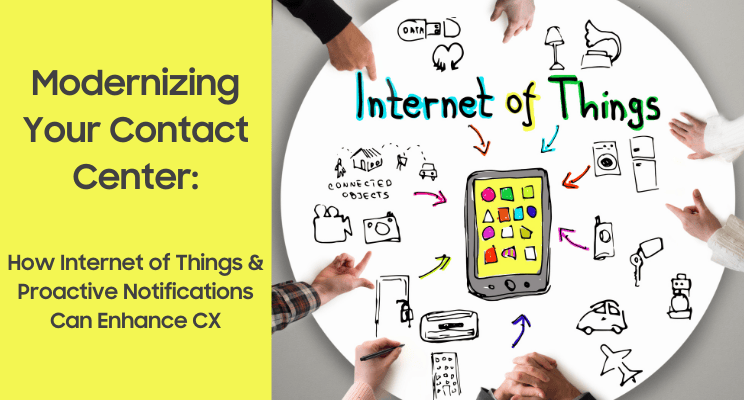
  • How Internet of Things (IoT) Can Proactively Enhance Customer Experience

    How Internet of Things (IoT) Can Proactively Enhance Customer Experience

    We live in a connected world. There were 22 billion devices connected to the internet in 2018 and it is projected to grow to 38.6 billion in 2025 and 50 billion in 2030 (Statista). To put that into perspective, there are currently 7.9 billion people in the world today and it is projected to grow to 8.2 billion by 2025 and 8.5 billion in 2030 (Worldometer). By 2030, it is projected that each person has approximately 9 connected devices!

    Have you ever stopped and thought about how many devices you own that are connected to the internet? My family of 7 has 32 devices that are or can be connected to the internet. This includes TVs, gaming consoles, mobile phones, tablets, vacuums and interactive voice assistants. I can check my phone and see where my family is. I can see how long they have been there and how fast they are going. We haven’t adopted smart home technology yet (such as connected lights, doorbell, thermostat, etc.) and our cars are not connected.

    Having all this data at my fingertips enables me to be connected and provides convenience. I am excited to think about all the ways customer experience can be enhanced by leveraging IoT and proactive notifications. People are busy and customers want frictionless experiences. When companies make the experience effortless (or low effort), customers are 94% more likely to repurchase and 88% more likely to spend more with your company (Customer Experience Board). IoT can enable an effortless experience as well as drive down contacts into your contact center.

    Proactive notifications are a part of providing a frictionless experience. 85% of consumers want to receive proactive notifications (Nuance). 70% of consumers view brands that send proactive notifications more favorably (Statista). A connected world enables companies to gain more insights and therefore, proactively reach out.

    Examples of IoT coupled with proactive notifications

    A Connected Car with Service Reminders

    That pesky light on the dash comes on to remind you your car needs an oil change. Imagine if you had a much more conversational reminder for car maintenance. For instance, based on mileage, you could get a proactive reminder sent to your phone not only for your oil change. You could receive a notification that it’s time to rotate your tires with useful information on how this will prolong the life of your tires and maintains your tire warranty. Taking it one step further, the reminder should offer you available appointments for your tire shop for that rotation.

    The check engine light comes on and you don’t know whether you should call your mechanic immediately or if it is safe to wait for a little bit before taking your car in. Imagine, by having a connected car, that the code associated with that light comes on. It alerts you that you have a faulty O2 sensor and that you should get that checked on the next maintenance appointment. It also sends a notification to your mechanic on record to check that during the next maintenance appointment with the information associated with the fault.

    A Connected Home with Conversational Proactive Alerts

    You have your home sprinkler system scheduled to turn on every morning at 5 AM. However, there is a 100% chance of rain one day during the week. Your sprinkler system sends you an alert that it is supposed to rain and asks you if you would like to turn off your sprinkler that day. Taking it one step further, it shows you the environmental impact of how much water you saved by turning it off for that day.

    Your furnace has malfunctioned and your thermostat notices that it is not able to keep your house at the preprogrammed temperature. It proactively alerts both you and your HVAC company of the issue. Your HVAC company is able to remotely access your furnace and diagnose the issue and sends you a notification that a technician needs to visit your home and correct the issue and provides you with the next appointment time which you are able to confirm or contact them for alternative times. This was all done before you noticed the temperature dropping in the home.

    Additional Examples of Proactive Alerts

    The internet goes out in your neighborhood. Your internet provider detects the issue and proactively notifies all the customers of the internet outage as well as the estimated time for restoral.

    You have scheduled installation of new internet service at your house. However, the technician is running late. Since they are in a connected vehicle, an alert is sent that they will be late to the service call. The Internet service provider has scheduling software that automatically looks for other available technicians in your area that could possibly service you faster and reroutes another technician to your home. You are proactively notified that the technician is running late and provides a new ETA with a link to check on where your technician is en-route.

    Summary

    Compare these examples to what you experience today. How many times have you had these sorts of effortless reminders? Unfortunately, these are not the norms. Reactive customer service is still the norm. As a consumer, these experience are often frustrating. Think about the customer experience you provide as a company. Where can you leverage IoT and proactive notifications to make it easier for your customers? By leveraging proactive notifications, you can increase customer satisfaction, loyalty and revenue as well as decrease operational costs.

  • Exceptional EX Results in Excellent CX and Drives Additional Revenue

    Exceptional EX Results in Excellent CX and Drives Additional Revenue

    Engaged, happy employees drive a better customer experience. A better customer experience drives additional revenue. Here are some interesting statistics on the link between employee experience, customer experience and higher revenue:

    • For each one-star improvement in a company’s Glassdoor rating, there’s a 1.3 point improvement in CSAT scores (Harvard Business Review).
    • Stock prices of Fortune’s 100 Best Companies to Work For list rose 14% per year from 1998 to 2005, while companies not on the list, stock prices only increased by 6% (Forbes).
    • Culture matters – companies that are ranked in the top 25% for culture show a return to shareholders 60% higher than median companies and 200% higher than those in the bottom 25% (McKinsey & Company).
    • A 5% increase in employee retention can boost profitability by 25 – 95% (Medium).
    • “If you run a contact center with 100 agents and have an industry-standard 45% attrition rate, you spend anywhere from $1.6 million to $4.8 million each year on turnover.” (Sharpen CX)

    We have to stop thinking of agent attrition as a “norm” that costs us recruiting fees and training costs. The economical impact of attrition reaches beyond the costs of recruitment and on-boarding – it impacts customer satisfaction and loyalty. Providing a great employee experience is key to driving down attrition.

    Keys to Driving a Better Employee Experience

    It starts with Culture

    Culture extends beyond the individual employee experiences. It includes the values, mission, attitudes and beliefs that a company has. High employee morale and a culture that cultivates relationships starts with leadership. Leaders need to model the behaviors and core beliefs in order for employees to adopt the vision and beliefs. Culture is the backbone of an organization and a strong culture results in three times higher returns to shareholders than companies without it (McKinsey). One of the most recent trends in culture is an innovative experience culture – a culture that works agilely to close the gap between the brand promise and the experiences delivered (Accenture). In fact, individual contributors & senior leaders see innovation as a top priority and building a culture around it will enhance the overall EX (Deloitte).

    Flexibility & Personalization

    Working from home became the norm for the past 15 months. Companies will need to provide options for flexibility and personalization as they start defining their post COVID-19 work policies. Personalizing the employee experience by offering flexible working arrangements that are curated based on employee preferences is key. Some employees may desire to return to work full-time, some may prefer a hybrid model and others may prefer to continue to work from home full-time. More companies are moving to a non-traditional work schedule by not looking at hours worked, but rather by deliverables completed.

    According to Gartner, when organizations offer employees flexibility with hours, they see 55% of their workforce as high performers (much higher than those organizations that are more rigid). While there continues to be bias towards in-office workers, full-time remote workers are 5% more likely to be high performers. As lines continue to blur, the conversation changes from work-life balance to overall well-being. In Deloitte’s 2021 Global Human Capital Trends report, Individual workers rank “improving worker well-being” as the third most important transformation effort, while senior executives rank it #8. Companies need to make well-being a priority and weave it into the company’s overall culture to drive better employee experience.

    Providing the Right Tools & Designing Optimized Processes

    I work with many companies on optimization and customer experience projects. One of the biggest opportunities I see is reducing the amount of human capital that is being used on administrative and repetitive tasks. We have to focus on eliminating employee friction and making it easier. Our teams want to do a good job, they want to take care of the customer. However, oftentimes, the tools and processes that are provided make it difficult to do that. Having optimization teams look at how to automate administrative tasks and eliminate friction will pay dividends. Tools should focus on optimization and building a sense of team. Collaboration tools that enable a distributed workforce to connect effectively are critical. By providing the right tools, you will not only happier employees, but also happier customers.

    Providing Upskilling and Training

    As more administrative tasks and informational/transactional work is automated, we have to focus on continued upskilling and training for our workforce. Today, 45% of the tasks that are handled by humans, could be automated. 60% of jobs could have 30% or more activities automated (McKinsey). The contact center agent is changing – their role is focused more on empathy, problem solving and relationship building now. There are additional roles in the contact center that weren’t there 10-15 years ago as new technologies are being introduced. Process improvement, automation, knowledge management and analytics jobs are being added and require a new level of skill. By continuing to invest in your workforce, you are building a resilient and innovative culture. This will result in a better employee experience experience.

    Summary

    As we emerge in the post COVID-19 world, transformation and innovation has accelerated. It is imperative that there is laser focus on the employee experience. This includes personalization, removing effort and friction, upskilling and creating an innovative and inclusive culture. By focusing on your employees, you will be building a better customer experience and adding to the bottom line.

  • AI Drives Efficiency and a Better Experience

    AI Drives Efficiency and a Better Experience

    While artificial intelligence has been an emerging technology for many years, adoption has accelerated as a result of COVID-19. According to Accenture, 3 out of 4 C-Suite executives believe if they don’t scale AI in the next five years, they risk going out of business. The #1 reason that companies are investing in AI is to improve customer experience with the second reason being cost reduction (Forbes). Gartner predicts that by 2022, 70% of customer interactions will involve emerging technology which includes AI. In fact, many companies are focused on providing an AI enabled customer experience in their contact centers to enhance the customer and employee experience. Today, we will discuss practical AI applications that can be leveraged in your contact center to not only drive efficiency, but also improve CX and EX.

    Conversational Bots

    Bots are the most common application of AI. According to Gartner, CIOs identified chatbots as the most common application for AI in their enterprises. Conversational bots are driving disruption. These bots which are NLU enabled, can handle transactional and informational inquiries while also gathering pre-routing tasks for more complex interactions. By gathering additional information about the customer and inquiry, these contacts can be routed more effectively and provide context to the agent which will enable the agent to provide a more personalized customer experience. Some best practices when deploying a bot include making it clear the customer is interacting with a bot and providing an easy way to get to a human agent at anytime.

    Some examples of bots include:

    • USAA’s conversational assistant which handles 20,000 contacts per week
    • Amtrak’s virtual assistant, Julie which can handle inquiries such as booking reservations, questions about schedules and guest reward programs
    • Emirates offering 4 chatbot personas to handle customer inquiries.

    Biometrics

    Voice authentication is one biometric solution that is gaining popularity in the contact center. Rather than leveraging a customer number, passwords or PINs, voice authentication identifies callers by the behavioral and physical characteristics of their voice. This enables companies to prevent fraud as well as reduce average handle time and increase self-service by having a better way to authenticate callers in the IVR. Organizations that are most likely to adopt this technology include healthcare, financial services and insurance where authentication is required. The FTC reported more than 2.1 million fraud reports in 2020 costing $3.3 billion (up from $1.8 billion in 2020). By reliably authenticating a customer in the IVR, the handle time is reduced. In one example, the Australian Taxation Office stated that handle times were reduced by 48 seconds by using voice authentication.

    Predictive Behavioral Routing

    Over the course of the last 20 years, we have seen contact routing mature from queues to skills-based routing. Now, there is a new era of contact routing that is infused with AI insights to create a hyper-personalized experience. This includes predictive behavioral routing and smart routing algorithms which anticipates why the customer is reaching out and tailoring the self-service and routing experience. According to Forbes, predictive behavioral routing relies on AI and analytics to match the callers with specific personality models and in turn those are routed to agents that can best handle those personality types. Predictive behavioral routing reduces handle time and increases productivity as well as leads to a better experience for the agent and the customer.

    Agent Assistance

    By leveraging real-time natural language understanding to interactions, agents get real-time insights and suggestions on the next best action when assisting customers. In addition, AI can analyze the customer sentiment and provide real-time coaching on soft-skills such as empathy and active listening. This not only provides a better customer experience, but also leads to a better agent experience. Agents are able to quickly adjust their responses and increase their soft-skills. In addition, this reduces the amount of supervision and coaching that is required by supervisors.

    Robotic Process Automation (RPA)

    Many times, agents become the human middleware between the customer, contact center platform, CRM and back-office systems. It is not unusual in legacy environments, for an agent to work in more than 5 different systems when servicing a customer. Oftentimes, the agent has to perform manual data entry processes across multiple systems to be able to serve a customer. RPA can be leveraged to perform repetitive tasks and processes and alleviate some of this burden from the agents. According to Maruti Techlabs, RPA can increase efficiency up to 90%. RPA which decreases handle time and overall effort. Some examples of where RPA is commonly used is creating invoices, issuing refunds, and migrating data between systems.

    AI Infused Quality Management

    In the contact center, the quality teams have always had challenges with having enough bandwidth to provide effective and efficient quality scoring. Some of the challenges have included low number of contacts sampled, random sampling of contacts, manual processes and subjective scoring that is not calibrated. However, imagine infusing your quality management platform with AI to eliminate some of these challenges. By leveraging AI in your quality management program, quality analytics can be applied to 100% of the contacts – scoring the contacts and providing quality insights with an increased accuracy and efficiency.

    AI Infused Interaction Analytics

    AI infused Interaction Analytics provides actionable insights into the contact center. IA not only identifies trends and reasons for contacts, it also can analyze customer sentiment. Taking this a step further, interaction analytics can identify reasons for repeat contacts. By combining customer sentiment with trends and reasons for contacts, contact centers can quickly identify customer friction points that need to be addressed in the organization. This enables organizations to become more customer centric.

    AI Infused WFM

    Forecasting and scheduling can be labor intensive and tedious leveraging various models. Variations in historical volumes can skew forecasts. This can include seasonal variations, holidays falling on different dates, an increase in volumes due to spam and patterns due to various incidents such as outages. In addition, omnichannel contact centers add complexity in creating an accurate forecast. AI enables a more accurate forecast taking the trending and SLAs for each channel into account when creating a forecast. With AI enabled workforce management platforms, the application can create more accurate forecasts by providing additional insights into the reasons for the variations and determine whether to include that data into the forecast. Taking this a step further, by leveraging AI, you can quickly schedule agents taking into account agent preferences and prioritizing personal preferences.

    As you can see, there are so many opportunities to leverage AI in the contact center to improve the experience for the agent and customer.

  • Siloed Systems Are The Death of Great CX & EX

    Siloed Systems Are The Death of Great CX & EX

    A few years ago, I was sitting in a hotel room in New Orleans, staring at a blank slide deck. The next morning, I was presenting at a kick off for a quote to cash project. I wanted to deliver a message showing how modernizing the quote to cash process would enhance customer experience.  The siloed systems which were a result of acquisitions and divisions operating independently were negatively impacting customer and employee experience. How could I craft a message that would resonate with finance, IT, operations & warehouse teams?

    Looking for inspiration, I started listening to our customer service calls for the day.  After listening to just the first call, I realized this is it!  The team needed to hear this. The call was a 12 minutes and transferred 4 times. The question was simple – why do I have a charge on my credit card from your company? Ideally, this customer should have been able to self-serve. However, at maximum, this should have been a one minute phone call.

    The next morning, I opened my presentation by sharing the “why” for the project. I played that 12 minute call. The discussion that followed was better than I had expected. I had anticipated the audience would show empathy towards the caller. I was proud when the first reaction wasn’t about the poor customer experience, but rather empathy towards the agent. This call became our rally cry, not just for the quote to cash project, but for other initiatives. This call would be played to the c-level and executives across the organization.

    Optimizing the Experience Through Integrations

    “That call” was not an easy fix. Many organizations that I have worked with have had similar challenges. Siloed systems and processes have been defining their customer experience. However, the modern customer expects hyper-personalization, automation and self-service. Customers want companies to respect their time and make it easy for them. Customers want companies to anticipate issues and proactively reach out. They want a frictionless experience. According to Forbes, 54% of customers will stop doing business with companies that deliver bad customer experience.  In addition, according to PWC, customers are willing to pay more for a better experience – up to 25% more.  

    Providing a great agent experience is also critical. According to McKinsey, engaged and happy call center employees are 8.5 times more likely to stay than leave within a year and are 3.3 times more likely to feel empowered to resolve customer issues. By providing the necessary tools to be able to do their job, they will stay engaged and in turn, provide better customer experience to your customers.

    What causes friction in an agent’s day? The number of systems they have to navigate and repetitive data entry are common concerns I hear when talking with agents. By integrating systems to pull and push data, you can make the experience easier for the agent and ultimately better for the customer.

    Getting Started with an Integrated Experience

    As you focus on providing a great customer and employee experience, it can be overwhelming to determine where to start. Take a look at your customer journeys. Where is there friction? Where can you offer self-service and a better experience by integrating systems? At a minimum, your contact center platform should be integrated with your CRM to offer a better experience. Look at your key contact drivers – what systems provide the information to answer those questions? Consider integrating your customer service platform with those systems so you can offer self-service. The key is to look at areas that you can iteratively improve the employee and customer experience.  Once you have made an improvement, measure, listen and analyze. Identify additional areas of improvement and integrations that will lower the level of effort for both your employees and your customers. By working in an agile manner, you can incrementally improve the experience which will result in higher CSAT scores and ultimately drive revenue to your bottom line.

  • Leveraging Interaction Analytics to Drive a Better Customer Experience

    Leveraging Interaction Analytics to Drive a Better Customer Experience

    Contact Centers are data rich, but until recently, they were information poor. Since customer conversations are unstructured data, it was difficult and time-intensive to gain insights. Interaction analytics enables organizations to convert the unstructured conversations into structured data that quickly provides actionable insights. IA can improve contact center operations by improving efficiency, increasing compliance and enhancing quality monitoring & coaching. In addition, Interaction analytics can drive more sales by increasing the conversion rate. Most importantly, leveraging interaction analytics can drive a better customer experience. According to McKinsey & Company, analytics can reduce AHT by 40%, increase containment rates by 5-20% as well as increasing conversion rates by 50% while also improving CSAT and employee experience.

    Leveraging Interaction Analytics for Improved Efficiency

    1. Reduced Contact Volume – By leveraging interaction analytics, you can identify your most common inquiries. Upon analyzing those inquiries, you can identify additional opportunities for self-service & common reasons for customer friction. By sharing these insights with other key stakeholders in your organizations, you can start removing customer friction which will ultimately lead to lower contacts into your contact center. In addition, you can identify contact drivers that could be automated through bots, FAQs or IVR.  Ensure that you are looking holistically at your self-service strategy and providing self-service opportunities including FAQs and automation where applicable.
    2. Reduced Average Handle Time – By being able to categorize key contact drivers and drill into common themes as well as identifying the areas with the highest handle time, you can quickly identify gaps in your agent training, agent knowledgebase or processes that need to be automated or refined.
    3. Improve Quality Management through QMA – Coaching and quality management can be more effective and efficient when integrated with interaction analytics. This enables you to automatically review 100% of your contacts for key words and phrases that are mandatory. In addition, it can enable you to quickly identify key issues and opportunities that need to be improved.

    Leveraging Interaction Analytics for Increased Sales

    By applying interaction analytics to your sales contacts, you can identify trends with closing rates. Are there some sales reps that are more effective than others? By identifying key traits and qualities of their interactions have compared to less successful sales agents, you can create a sales enablement program that increases overall conversion rate. In addition, interaction analytics and AI can also be leveraged for more effective upsells, identifying the customer profiles and product types that would most effectively result in a sale.

    Adherence and Compliance

    Contact centers have to adhere to many guidelines including TCPA, PCI, GDPR to name a few. Adherence to these guidelines is critical to avoid high fines and maintain customer satisfaction. The company needs to act quickly if a customer asks to be placed on your do not call list or their personal data to be removed. Analytics can quickly identify those contacts to ensure compliance.

    Improved Customer Experience

    When I worked in the contact center, I would often be asked details about the contacts. What are the reasons for calls? What are customers saying? It was difficult to gain the insights necessary to effectively answer that question without a great level of effort. Dispositions would provide a high level reason for contacts, but didn’t provide the details needed to effectively answer that question. A product defect would drive additional customer inquiries, but I wasn’t able to quickly get to the details. It was difficult to isolate those contacts and provide insights. 

    Interaction Analytics can enable you to gain quick insights and be able to answer these types of questions more accurately without as much effort and with much more data. You will be able to proactively identify areas that cause friction and identify root causes more quickly.

    Interaction analytics enables your organization to become a customer centric organization. You can analyze customer sentiment to identify areas that cause customer frustration as well as areas that delight the customer. By quickly being able to identify and reduce/eliminate friction, will increase customer satisfaction. Leveraging key insights along with customer sentiment will enable you to be able to prioritize improvements in the customer experience.

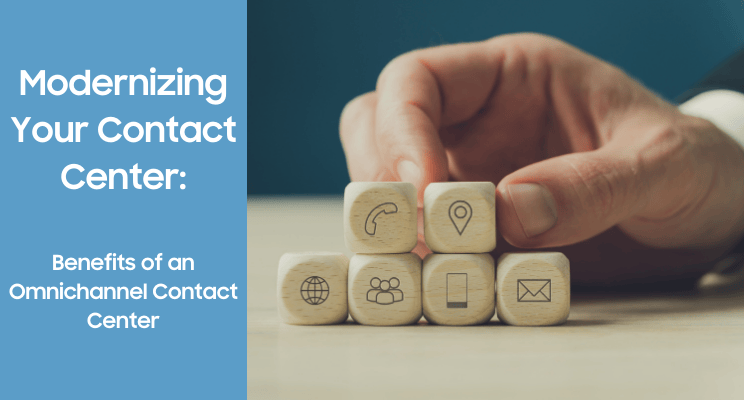
  • 5 Benefits of an Omnichannel Contact Center – Key to Providing Amazing Customer Service

    5 Benefits of an Omnichannel Contact Center – Key to Providing Amazing Customer Service

    For the last several weeks, we have been discussing various contact center channels. This includes the IVR, email, social media, chat, chatbots and messaging. Today, we will discuss the benefits of having an Omnichannel Contact Center and its role in providing an amazing customer experience.

    Multichannel vs. omnichannel contact center

    Multichannel vs. Omnichannel Contact Center

    While both multichannel and omnichannel support handling more than just voice, there are key differentiators.

    Multichannel Contact Center:

    A multichannel contact center supports multiple channels or touchpoints. This enables the customer to interact with the company on the channel of their choice. However, channels are typically siloed resulting in a fragmented customer experience. If the customer changes channels during their engagement, the contact center applications report these as separate interactions.

    Omnichannel Contact Center:

    An Omnichannel contact center supports multiple channels on a single platform in a connected experience. This enables the agents to see the context associated the customer’s previous interactions (regardless of channel). In addition, it allows the customer & agent to move between channels during an interaction seamlessly – maintaining better reporting, analytics and customer experience.

    Omnichannel contact centers lead to happier, more efficient agents

    Benefits of an Omnichannel Contact Center

    Connected Customer Experience

    According to CX Today, the number of channels that a customer uses has increased significantly. 15 years ago, they used 2 channels on average; today they use on average of 6 touchpoints. 72% of customers expect companies to know their purchase history regardless of channel they engage on. Customers want to be able to interact on the channel of their choice and not have to repeat themselves when changing channels.

    Higher Customer Satisfaction Resulting in Higher Revenue

    There is a direct correlation between customer experience and revenue. According to McKinsey, digital transformation and a focus on customer experience can generate an increase in customer satisfaction by 20-30% and increase revenue by 20-50%. Having a strong Omnichannel strategy that supports your company’s digital transformation is critical. In addition, it is critical to focus on customer experience in the contact center. In fact, according to CIO.com, “The modern contact center is becoming the customer experience center.” It is critical to provide not just automation but human engagement to enhance the customer experience.

    Increased Agent Efficiency

    With an omnichannel contact center, you can create robust routing rules. This enables an agent to work multiple contacts at the same time. In addition, with a single set of routing rules, you can effectively prioritize real-time contacts. By eliminating point solutions and having a single pane of glass for all contacts, you will also enhance agent experience. By providing the right tools and making it easy, leads to more efficient & happier agents.

    Increased Operational Efficiency

    By managing all your contacts with one routing engine, and having multi-skilled agents, you will be able to not only will agents be more efficient (lower average handle time), but they will be higher utilized. You will be able to effectively forecast and staff across all your channels. This will result in additional operational efficiencies for your contact center.

    Better Reporting & Analytics

    Having all your interactions in one platform will provide consistent reporting. In addition, you can apply interaction analytics to all your contacts. This will enable you to identify This will provide better insights on why your customers engage with you and be able to identify areas of friction that need to be addressed in the customer experience.

    Omnichannel contact centers lead to happier customers

    The Whole is Greater Than the Sum of the Parts

    Aristotle said, “The whole is greater than the sum of the parts.” Omnichannel is the whole whereas multichannel is the sum of the parts. Having an omnichannel contact center provides so many benefits for the agent, company and the customer. It drives out friction in your customer experience as well as enhances the experience for the agents and customers. It is key to providing amazing customer service.