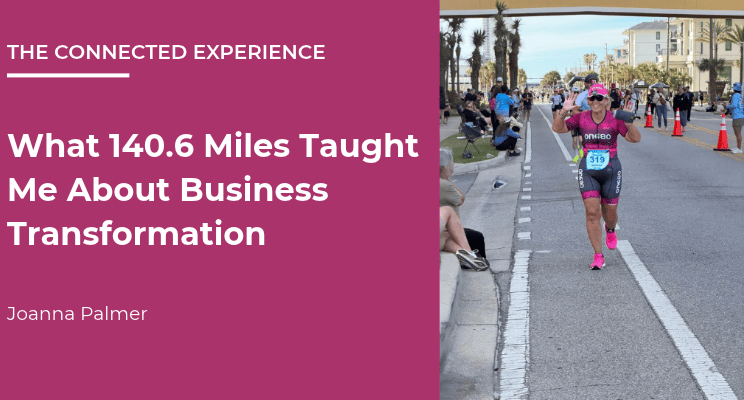
Sometimes the things you didn’t anticipate teach you the most.
This past weekend, I headed to Florida to compete in my fourth full-distance IRONMAN. After a year of training, I was hopeful this would be my best race yet. I had put in the work, learned from previous races, and felt confident I was prepared to set a new personal record.
And for much of the day, it looked like that preparation was paying off.
I set personal records in both the swim and bike and headed into the marathon on pace to achieve my goals. But unexpected challenges during the run quickly changed the outcome.
I didn’t get the finish time I’d hoped for, but I came away with some valuable lessons.
Interestingly, those lessons have a lot in common with what I’ve experienced helping organizations modernize their contact centers, adopt AI, and transform their customer experience.
1. Think Bigger About What Success Means
When I started this journey, it was part of a larger effort to lose weight and improve my health. However, I intentionally chose not to focus on a number on the scale. Instead, I wanted to accomplish something I wasn’t sure was possible.
The weight loss became a result of the changes I was making rather than my primary measure of success.
I hired a coach to help me complete my first triathlon. When I shared my goal, he challenged me to think bigger.
I think organizations sometimes approach transformation with goals that are too narrowly focused:
- Reduce operating costs by 20%.
- Automate 30% of customer interactions.
- Improve agent productivity by 15%.
Those are reasonable objectives, and they’re important for building business cases and measuring results. But are they ambitious enough?
What if, instead of asking how many customer interactions we can automate, we asked how we could eliminate the reasons customers need to contact us in the first place?
What if we focused less on reducing the cost of customer service and more on changing the value our contact centers deliver?
And what if we recognized that some of the biggest opportunities to improve customer experience sit outside the contact center entirely?
Sometimes the most valuable thing an advisor can do is challenge an organization to think beyond what it originally believed was possible. That’s exactly what my coach did for me.
My own definition of success has evolved as well. In 2024, finishing my first IRONMAN before the cutoff was enough. During my second IRONMAN in Arizona, I improved my time by two hours but also experienced some health challenges. Those challenges continued during IRONMAN Texas earlier this year.
By the time I returned to Florida, I understood that a faster finish time alone wouldn’t define a successful race. I also needed to finish healthy.
The same is true of transformation. Achieving an operational target doesn’t necessarily mean you’ve achieved the business outcome you intended.
An AI agent might achieve a 60% containment rate, but are customers actually getting their issues resolved? Are they calling back? Are employees spending more time handling escalations? Have we eliminated unnecessary customer effort or simply shifted it somewhere else? And is the organization realizing the financial benefits it projected?
The numbers matter, but they don’t always tell the whole story.
2. Test the Entire Experience, Not Just the Individual Components
Leading up to Florida, I’d completed the physical training. But some of my most important preparation involved experimenting with nutrition and developing a plan that would help me avoid the challenges I’d experienced in previous races.
I’d tested different approaches during long bike rides and runs. Not every test went perfectly, but I believed we had developed the most sound plan based on the information available.
And for much of the race, it worked.
I had an incredible swim and bike, setting personal records in both disciplines. I was on pace to achieve my goals heading into the marathon. Unfortunately, significant challenges during the run forced me to adjust my approach, and I ultimately finished slower than I had in Arizona. As I’ve started reviewing the race with my team, one thing has become clear: I hadn’t tested the complete experience as thoroughly as I thought. I’d spent considerable time testing my fueling strategies during long bike rides and runs independently. What I hadn’t done enough of was testing how those strategies worked together during extended bike-to-run sessions. We haven’t determined whether that contributed to what happened, but it’s an important gap in our preparation that we need to explore.
I see a parallel to enterprise AI transformation. Organizations often invest considerable effort testing individual components of a solution:
- Can the AI agent accurately respond to customer inquiries?
- Can integrations retrieve the required information?
- Is the knowledge content accurate?
- Do escalation workflows function as designed?
All important questions. But what happens when we put everything together?
Consider a customer who starts with an AI agent, needs information from multiple systems, and ultimately requires assistance from an employee.
Does the interaction work seamlessly from beginning to end? Does the employee receive the necessary context? Does the customer have to repeat information? And was the issue actually resolved?
Now consider what happens when the customer’s issue originates somewhere else in the business. Perhaps an incorrect order, a billing discrepancy, or a policy that creates unnecessary friction.
Even a perfectly functioning AI agent can’t fix a broken process it has no ability to change.
Successful component testing doesn’t guarantee a successful end-to-end experience.
We need to test the experience the way customers actually encounter it, across systems, departments, and handoffs, not just the way individual teams have designed their part of it.
It’s a principle I’ve emphasized professionally for years. Florida gave me a very personal reminder of why it matters.
3. When the Outcome Falls Short, Go Back to the Basics
One of the first things we’ve started doing since Florida is reevaluating the variables that have changed since my last race without significant challenges.
Rather than introducing another entirely new approach, we’re returning to what worked previously, removing unnecessary variables, and testing changes individually.
The goal is to better understand what works, what doesn’t, and why.
I’ve seen organizations face similar challenges with technology implementations.
An AI agent isn’t delivering the expected results, so the immediate reaction is to change the prompts, update the knowledge base, modify workflows, adjust escalation rules, and introduce additional capabilities.
But when everything changes at once, how do we know which adjustment improved performance? Or which one introduced a new problem?
Sometimes the best next step isn’t adding more functionality. It’s simplifying the process, establishing a reliable baseline, and making deliberate changes based on what the data tells us.
Sometimes taking the time to understand what’s driving the results is the fastest way to make meaningful progress.
Coming Full Circle
Two years ago, I crossed the finish line at IRONMAN Florida thrilled simply to have finished.
This year, I returned with more experience, better preparation, and a much deeper understanding of what it takes to complete 140.6 miles.
I didn’t achieve the result I’d hoped for. But I finished more than an hour and forty minutes faster than my first Florida race, achieved personal records in two disciplines, and learned something important about the limitations of my preparation.
There are still challenges to work through, and I’ve already started working with my team to figure out what needs to change.
It’s also time to return to something I’ve been away from for a while.
Several years ago, I started writing a LinkedIn article series called Modernizing Your Contact Center. A lot has changed in the customer experience industry since then, particularly with generative AI and increasingly capable AI agents. But many of the principles I wrote about remain just as relevant today.
One thing I’ve become even more convinced of is that customer experience doesn’t belong to one department. It’s shaped by decisions made across the entire organization, from the products we design and the policies we establish to the technology we implement and the employees who serve our customers.
That’s why I’m bringing my writing back under a broader theme: The Connected Experience.
I want to continue to explore where customer experience, AI, and business strategy intersect. I’ll be sharing what I’m seeing across the industry, questioning some of the assumptions we make about transformation, and learning from the experiences of other CX leaders.
When I think about where I started and where I am today, I’m proud of the progress I’ve made. But I’m also very aware that I haven’t figured everything out.
The same is true of business transformation. We can have the right strategy, invest in the right technology, and execute individual parts of a plan exceptionally well, yet still fall short of the outcome we intended.
What matters is being willing to question our assumptions, understand how everything works together, and use what we’ve learned to make the next attempt better.
I’d love to hear your thoughts. Have you ever had a project where all the individual components worked as expected, but the overall outcome fell short? What did you learn when you looked at how everything worked together?