Author: Joanna Palmer

  • The Connected Experience: Creating Experiences People Want to Come Back For

    The Connected Experience: Creating Experiences People Want to Come Back For

    Twenty-two years ago, I had absolutely no idea how to cook a turkey, much less prepare an entire Thanksgiving dinner.

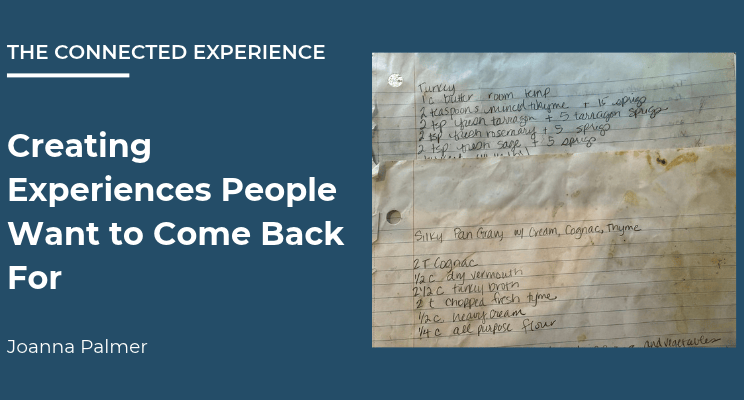
    I had an insert from the Kansas City Star that included holiday recipes. I used those recipes to learn how to make a turkey and gravy, and to this day, I still use those same recipes. The handwritten recipes are stained and tattered, but they remain the foundation of our Thanksgiving meal.

    When I decided to start hosting, my oldest daughter was almost 2 years old, and I wanted to create positive, lasting memories for her. I remember going to my parents’ house for Thanksgiving and how noticeably stressed my mom would be preparing a large meal for our extended family.  I wanted to remove that stress for her and create lasting positive memories for future Thanksgivings.

    For me, preparing a large family dinner is something I genuinely enjoy. I find it relaxing, and I wanted to create an experience where everyone could come together, enjoy great food, have fun and make memories.

    My oldest daughter is now 23, and my family lovingly refer to Thanksgiving as “our Super Bowl.” It has become a day that both family and friends look forward to every year. As the kids have gotten older, they have started bringing their significant others and friends. Everyone knows they are welcome, and regardless of how many people show up, there will be plenty of food.

    Thanksgiving is my favorite holiday. It’s about connections, relationships and creating an experience that people want to come back for.

    And isn’t that ultimately what we are trying to accomplish with customer experience?

    Start With the Experience You Want to Create

    When I started hosting Thanksgiving, my objective wasn’t simply to serve dinner. If that had been the goal, there certainly would have been easier and more efficient ways to accomplish it.

    My objective was to create an experience.

    There is an important distinction between the two, and I think it’s one that organizations sometimes lose sight of as they embark on customer experience and AI transformation initiatives.

    We spend a tremendous amount of time discussing how many interactions we can automate, how we can reduce our cost to serve, how we can improve employee productivity and how we can increase self-service containment.

    These are all legitimate business objectives. Organizations need to operate efficiently, and AI presents significant opportunities to accomplish this.

    But what if we started with a different set of questions?

    • What do we want our customers to experience?
    • What do our customers already value about doing business with us?
    • What could we do to make their lives easier?
    • What would make them choose to do business with us again?
    • What experiences are we not delivering today that AI could make possible?

    The answers to these questions might fundamentally change how we approach our AI investments, prioritize use cases and measure success.

    Preserve What’s Working

    Over the years, my Thanksgiving menu has evolved. I’ve discovered new recipes on Pinterest, incorporated a green bean casserole recipe from a Campbell’s soup cookbook and added to the meal as our family has grown.

    But those original turkey and gravy recipes? They aren’t going anywhere.

    There are undoubtedly thousands of turkey recipes available online today. I could ask AI to recommend a new recipe, identify a more efficient cooking method or suggest an entirely different approach to preparing Thanksgiving dinner.

    But why would I change something that works so well and has become part of what people look forward to every year?

    I don’t need to reinvent the entire meal to make the experience better.  There is a similar lesson for organizations embarking on transformation.

    When we introduce new technology, particularly something as transformative as AI, there can be a tendency to focus on what we can replace rather than what we should preserve.

    Before redesigning a customer journey, automating an interaction or changing an established process, we should understand what is working well today and why.

    Perhaps it’s the expertise of a tenured employee who knows how to navigate complex customer situations. Perhaps it’s a personal interaction that differentiates your organization from its competitors. Perhaps it’s a process that, while not particularly sophisticated from a technology perspective, consistently delivers an exceptional customer outcome.

    These are assets that should inform your transformation strategy, not become unintended casualties of it.

    This is where AI can play a particularly interesting role. We can use conversational intelligence to understand not only where customer interactions are going wrong, but also what is happening when they go exceptionally well.

    What are our most successful employees doing differently? What experiences are customers responding positively to? How can we make those experiences available to more customers?

    Sometimes the greatest opportunity for transformation isn’t creating something entirely new. It’s taking what we already do exceptionally well and finding ways to deliver it more consistently and at scale.

    Transformation doesn’t require us to abandon what works. It gives us an opportunity to build upon it.

    Anticipating Needs Rather Than Simply Responding to Them

    One of the things our friends and family know about Thanksgiving at our house is that there will always be enough food. They don’t need to worry about whether there is room for another person or whether bringing a friend will create an inconvenience. Everyone is welcome.

    As organizations, how often do we design experiences around anticipating our customers’ needs rather than simply responding to them?

    A customer whose flight has been canceled shouldn’t necessarily have to contact an airline to understand their options for getting home.

    A hotel guest traveling with their family may have very different needs than that same guest traveling for business, even though their customer profile hasn’t changed.

    A customer purchasing a new piece of technology may benefit from proactive guidance on setup and installation rather than having to contact technical support when something goes wrong.

    AI gives us an opportunity to better understand context, anticipate needs and deliver experiences that historically would have been difficult or expensive to provide at scale.

    Yet much of the conversation around AI remains focused on handling the interactions we already have, rather than reimagining the experiences we could create.

    There is a significant opportunity in that distinction.

    Consistency Doesn’t Mean Everything Has to Stay the Same

    Our Thanksgiving gatherings look very different today than they did 22 years ago. The kids have grown up, new people have joined us, and the dynamics of the day have changed.

    The experience has evolved alongside the people who participate in it.

    But there are certain things everyone has come to expect. They know they will be welcomed, there will be great food, and it will be a day filled with family, friends and fun.

    That consistency is part of what makes the tradition special.

    The same is true in customer experience.

    Customers develop expectations based on their previous interactions with an organization. When those expectations are consistently met, trust grows.

    But consistency doesn’t mean delivering the exact same experience to every customer or expecting customers to have the same needs they had five years ago.

    One of the most compelling opportunities with AI is its ability to help organizations deliver greater consistency while adapting to the individual needs and circumstances of their customers.

    Imagine employees having access to the right information at the right time, regardless of their tenure. Imagine customers being able to move between digital and human-assisted channels without having to start their conversation over. Imagine an organization understanding the context of a customer’s needs rather than treating every interaction as an isolated transaction.

    These capabilities are about much more than operational efficiency. They are about creating confidence in the experience a customer can expect from your organization while allowing that experience to evolve.

    Efficiency Should Enable a Better Experience

    If my primary objective for Thanksgiving were to minimize the amount of time I spend preparing dinner, reduce the cost per person and eliminate unnecessary activities, I could certainly redesign the day.

    I could simplify the menu, limit the number of guests and shorten the gathering.

    By those measures, Thanksgiving might become considerably more efficient.

    But would it still be our Super Bowl?

    Definitely not.  Imagine if I served canned gravy instead of the homemade gravy that people talk about year round!  There would be a revolt!

    That doesn’t mean I shouldn’t look for ways to make preparation easier. If something allows me to spend less time on a repetitive task and more time enjoying the day with family and friends, that’s a win.  I have started preparing more of the food in advance so things are not so frantic in the kitchen when guests arrive.

    The important thing is that efficiency serves the experience rather than becoming the experience.

    What if, in addition to reducing operational costs, we used AI to:

    • Give employees more time to focus on complex customer needs and meaningful conversations.
    • Provide personalized experiences that previously weren’t economically feasible.
    • Identify recurring customer frustrations and address their root causes.
    • Create proactive experiences that eliminate the need for customers to seek assistance.
    • Uncover unmet customer needs and opportunities to deliver additional value.

    There is a difference between using AI to do what we do today at a lower cost and using AI to create something better than what exists today.

    Organizations should be exploring both.

    Are We Measuring What Really Matters?

    I don’t measure the success of Thanksgiving by how quickly everyone eats, how much food is consumed per person or how efficiently I clean the kitchen.

    I measure it by the experience people have.

    Did everyone feel welcome? Did they enjoy themselves? Did we create new memories? Are they looking forward to coming back next year?

    As organizations invest in AI, we need to be equally thoughtful about how we define success.

    A reduction in average handle time doesn’t necessarily mean a customer had a better experience. An increase in containment doesn’t necessarily mean a customer’s issue was resolved. A reduction in contact volume doesn’t necessarily mean customers are happier.

    We need to connect operational improvements to meaningful customer and business outcomes.

    Are customers making less effort to accomplish what they need? Are we resolving issues more effectively? Are we strengthening customer relationships? Are customers choosing to stay with us, purchase more from us and recommend us to others?

    And just as importantly, are we preserving the things that made our customers choose us in the first place?

    These are the outcomes that help us understand whether we are truly transforming the customer experience.

    Creating Experiences Worth Coming Back For

    This week, I’ll once again pull out those stained and tattered turkey and gravy recipes. I’ll reference some recipes on Pinterest and pull out others from cookbooks I’ve had for years.

    Some of what I’ll prepare is exactly what I prepared two decades ago. Other things have been added along the way.

    It’s a combination of the old and the new, each contributing something to the overall experience.

    I think that’s a useful way to think about transformation.

    As you evaluate your organization’s AI transformation strategy, consider four questions:

    • What experiences are worth preserving?
    • Where are there opportunities to make those experiences even better?
    • What new experiences can we create that weren’t possible before?
    • How will we know whether we’ve made a meaningful difference for our customers?

    The goal shouldn’t simply be to create a more efficient version of the experience we deliver today. It should be to create an experience our customers want to come back for.

    Technology will continue to evolve. Customer expectations will change. New capabilities will emerge that we haven’t even considered yet.

    Not everything needs to change. Sometimes, the foundation of a great experience is already there. We just need to recognize it, protect it and build upon it.

    This Thanksgiving, I’m grateful for the connections, relationships and memories that have been created around our table over the years, and for the opportunity to continue creating them.

    Happy Thanksgiving!

  • What 140.6 Miles Taught Me About Business Transformation

    What 140.6 Miles Taught Me About Business Transformation

    Sometimes the things you didn’t anticipate teach you the most.

    This past weekend, I headed to Florida to compete in my fourth full-distance IRONMAN. After a year of training, I was hopeful this would be my best race yet. I had put in the work, learned from previous races, and felt confident I was prepared to set a new personal record.

    And for much of the day, it looked like that preparation was paying off.

    I set personal records in both the swim and bike and headed into the marathon on pace to achieve my goals. But unexpected challenges during the run quickly changed the outcome.

    I didn’t get the finish time I’d hoped for, but I came away with some valuable lessons.

    Interestingly, those lessons have a lot in common with what I’ve experienced helping organizations modernize their contact centers, adopt AI, and transform their customer experience.

    1. Think Bigger About What Success Means

    When I started this journey, it was part of a larger effort to lose weight and improve my health. However, I intentionally chose not to focus on a number on the scale. Instead, I wanted to accomplish something I wasn’t sure was possible.

    The weight loss became a result of the changes I was making rather than my primary measure of success.

    I hired a coach to help me complete my first triathlon. When I shared my goal, he challenged me to think bigger.

    I think organizations sometimes approach transformation with goals that are too narrowly focused:

    • Reduce operating costs by 20%.
    • Automate 30% of customer interactions.
    • Improve agent productivity by 15%.

    Those are reasonable objectives, and they’re important for building business cases and measuring results. But are they ambitious enough?

    What if, instead of asking how many customer interactions we can automate, we asked how we could eliminate the reasons customers need to contact us in the first place?

    What if we focused less on reducing the cost of customer service and more on changing the value our contact centers deliver?

    And what if we recognized that some of the biggest opportunities to improve customer experience sit outside the contact center entirely?

    Sometimes the most valuable thing an advisor can do is challenge an organization to think beyond what it originally believed was possible. That’s exactly what my coach did for me.

    My own definition of success has evolved as well. In 2024, finishing my first IRONMAN before the cutoff was enough. During my second IRONMAN in Arizona, I improved my time by two hours but also experienced some health challenges. Those challenges continued during IRONMAN Texas earlier this year.

    By the time I returned to Florida, I understood that a faster finish time alone wouldn’t define a successful race. I also needed to finish healthy.

    The same is true of transformation. Achieving an operational target doesn’t necessarily mean you’ve achieved the business outcome you intended.

    An AI agent might achieve a 60% containment rate, but are customers actually getting their issues resolved? Are they calling back? Are employees spending more time handling escalations? Have we eliminated unnecessary customer effort or simply shifted it somewhere else? And is the organization realizing the financial benefits it projected?

    The numbers matter, but they don’t always tell the whole story.

    2. Test the Entire Experience, Not Just the Individual Components

    Leading up to Florida, I’d completed the physical training. But some of my most important preparation involved experimenting with nutrition and developing a plan that would help me avoid the challenges I’d experienced in previous races.

    I’d tested different approaches during long bike rides and runs. Not every test went perfectly, but I believed we had developed the most sound plan based on the information available.

    And for much of the race, it worked.

    I had an incredible swim and bike, setting personal records in both disciplines. I was on pace to achieve my goals heading into the marathon. Unfortunately, significant challenges during the run forced me to adjust my approach, and I ultimately finished slower than I had in Arizona. As I’ve started reviewing the race with my team, one thing has become clear: I hadn’t tested the complete experience as thoroughly as I thought. I’d spent considerable time testing my fueling strategies during long bike rides and runs independently. What I hadn’t done enough of was testing how those strategies worked together during extended bike-to-run sessions. We haven’t determined whether that contributed to what happened, but it’s an important gap in our preparation that we need to explore.

    I see a parallel to enterprise AI transformation. Organizations often invest considerable effort testing individual components of a solution:

    • Can the AI agent accurately respond to customer inquiries?
    • Can integrations retrieve the required information?
    • Is the knowledge content accurate?
    • Do escalation workflows function as designed?

    All important questions. But what happens when we put everything together?

    Consider a customer who starts with an AI agent, needs information from multiple systems, and ultimately requires assistance from an employee.

    Does the interaction work seamlessly from beginning to end? Does the employee receive the necessary context? Does the customer have to repeat information? And was the issue actually resolved?

    Now consider what happens when the customer’s issue originates somewhere else in the business. Perhaps an incorrect order, a billing discrepancy, or a policy that creates unnecessary friction.

    Even a perfectly functioning AI agent can’t fix a broken process it has no ability to change.

    Successful component testing doesn’t guarantee a successful end-to-end experience.

    We need to test the experience the way customers actually encounter it, across systems, departments, and handoffs, not just the way individual teams have designed their part of it.

    It’s a principle I’ve emphasized professionally for years. Florida gave me a very personal reminder of why it matters.

    3. When the Outcome Falls Short, Go Back to the Basics

    One of the first things we’ve started doing since Florida is reevaluating the variables that have changed since my last race without significant challenges.

    Rather than introducing another entirely new approach, we’re returning to what worked previously, removing unnecessary variables, and testing changes individually.

    The goal is to better understand what works, what doesn’t, and why.

    I’ve seen organizations face similar challenges with technology implementations.

    An AI agent isn’t delivering the expected results, so the immediate reaction is to change the prompts, update the knowledge base, modify workflows, adjust escalation rules, and introduce additional capabilities.

    But when everything changes at once, how do we know which adjustment improved performance? Or which one introduced a new problem?

    Sometimes the best next step isn’t adding more functionality. It’s simplifying the process, establishing a reliable baseline, and making deliberate changes based on what the data tells us.

    Sometimes taking the time to understand what’s driving the results is the fastest way to make meaningful progress.

    Coming Full Circle

    Two years ago, I crossed the finish line at IRONMAN Florida thrilled simply to have finished.

    This year, I returned with more experience, better preparation, and a much deeper understanding of what it takes to complete 140.6 miles.

    I didn’t achieve the result I’d hoped for. But I finished more than an hour and forty minutes faster than my first Florida race, achieved personal records in two disciplines, and learned something important about the limitations of my preparation.

    There are still challenges to work through, and I’ve already started working with my team to figure out what needs to change.

    It’s also time to return to something I’ve been away from for a while.

    Several years ago, I started writing a LinkedIn article series called Modernizing Your Contact Center. A lot has changed in the customer experience industry since then, particularly with generative AI and increasingly capable AI agents. But many of the principles I wrote about remain just as relevant today.

    One thing I’ve become even more convinced of is that customer experience doesn’t belong to one department. It’s shaped by decisions made across the entire organization, from the products we design and the policies we establish to the technology we implement and the employees who serve our customers.

    That’s why I’m bringing my writing back under a broader theme: The Connected Experience.

    I want to continue to explore where customer experience, AI, and business strategy intersect. I’ll be sharing what I’m seeing across the industry, questioning some of the assumptions we make about transformation, and learning from the experiences of other CX leaders.

    When I think about where I started and where I am today, I’m proud of the progress I’ve made. But I’m also very aware that I haven’t figured everything out.

    The same is true of business transformation. We can have the right strategy, invest in the right technology, and execute individual parts of a plan exceptionally well, yet still fall short of the outcome we intended.

    What matters is being willing to question our assumptions, understand how everything works together, and use what we’ve learned to make the next attempt better.

    I’d love to hear your thoughts. Have you ever had a project where all the individual components worked as expected, but the overall outcome fell short? What did you learn when you looked at how everything worked together?

  • Web Chat Best Practices

    Web Chat Best Practices

    According to Forrester Consulting, web chat has many benefits including a 305% ROI in 6 months when used as a sales channel, 120% ROI in 6 months when used as a service channel and 59% call deflection. According to the Benchmark Portal, a webchat contact costs 1/3 the cost of a phone contact. Forrester also predicts that digital customer service interactions will increase by 40% in 2021. The good news? According to Zoho, 2/3 of companies already use live chat for customer support.

    However, customer’s expectations are higher than ever and the majority of companies are not meeting those expectations. Salesforce reports that 71% of customers have used multiple channels to start and complete a single transactions and they expect connected experiences. Whether you are deploying web chat for the first time or even if you already have web chat implemented, now would be a good time to review your chat experience and ensure that you are following best practices and tune where needed.

    1. Determine Your Call to Action Method – Static vs. Proactive: There are 2 types of chat touts – static and proactive.
      • Static – This is sometimes referred to as reactive chat. The chat icon is “always” available on the page and remains there whenever you are on the page. Best practices include having static chat touts (or call to actions) in the same place on each page so your customers can easily find it. Typically these touts are on the right-hand side of the page. Static chat enables a customer to reach out to your organization anytime they have a question. The key to the best customer experience is ensure the chat tout is consistently displayed and highly visible to the customer – don’t require them to try and find the “contact us” page in order to chat with you.
      • Proactive – This is more of a customized experience where the chat icon pops up based on various rules on the website. Various rules can be configured – for example, if a person is idle on a webpage for a configured amount of time or if they abandon their shopping cart, the chat call to action can pop up. This can be a riskier customer experience – if not configured correctly, it can be annoying. If done correctly, it can drive more sales and revenue. If you have proactive deployed, you should look at customer sentiment often to ensure that the chat experience is meeting customer’s needs.
    2. Personalize the Chat experience – 84% of customers say being treated like a person rather than a number is very important to earning their business (Salesforce). If the customer has authenticated on your website, pass that information to the chat platform if they decide to chat with you. You should not ask for their name or identifying information that you could leverage from your CRM. Additionally, you should also pass the CRM record to the agent when presenting them with the chat. If the customer is not authenticated, if you have a pre-chat form and ask identifying information, send that info to the CRM to personalize the experience.
    3. Provide Expected Wait Time – Expected wait time should be provided to set expectations on how long the caller should expect to wait for an agent. Offer self-service as an alternative but do not force self-service. If you are unable to provide expected wait time, then provide position in queue (which is less helpful as there are many variables that could play into their wait time including average handle time and number of agents that are handling chat).
    4. Pre-Chat Form – If you have several departments handling chat, the ideal routing rules would be using attributes from the page the chat is originating from & customer to route the chat effectively. If that is not possible, use a pre-chat form to ask what they are inquiring about which may include a drop down of topics. Remember to not use company jargon in the drop-down but rather how customers would describe what they would be inquiring about.
    5. Offer Chat Transcripts – Always offer chat transcripts to the customer so that they have a record of their interaction. Some user interfaces allow the customer to request the chat transcript via email so that the agent doesn’t have to remember to ask.
    6. Determine After-Hours Treatment – There are a number of different ways to handle after-hours treatment for chat. Customers expectations are to have 24×7 service – some contact centers outsource outside their hours. Some other alternatives include:
      • Leveraging a Chatbot – Leverage a chatbot to handle simple inquiries and if a customer requests to speak with an agent, then advise them of the hours of operation.
      • Remove Chat Tout After-hours – Program the webpage to hide the chat tout call to action when outside of the contact center hours.
      • Display an After-hours Message – If a customer elects to chat afterhours, you could display an after-hours pop-up that provides the hours of operation. This can add friction to the customer interaction due to providing the expectation that they will be chatting based on the availability of the chat tout on the webpage.
      • Provide a “Contact Us” Email Form – Indicate it is after hours and provide a contact us form in which you can respond back to the customer via email. Ensure that your responses for these messages are prioritized as the customer expectations are different for chat vs. email (which customers expect a response in 24 hours).
    7. Agent Training and Chat Procedures –
      • Ensure that your training highlights the differences in email responses and chat responses. Email is much more formal whereas chat is considered more casual and shorter answers are acceptable and most times desired. Oftentimes, responses for emails start as “Thank you for contacting [company] about your issue [restate issue]. We are very sorry about the inconvenience this caused…” For chat, the customer service agent can start addressing the issue/question (of course with empathy) instead of restating the issue.
      • Determine what your company’s personality should be in chat – Can agents use emojis? Is shorthand/acronyms acceptable?
      • Determine how you handle customers that are no longer responsive during chat. How long should an agent wait prior to disconnecting a customer? What messaging should be sent prior to disconnect?
      • Provide quick responses for commonly asked questions, but also encourage free form when it provides a better customer experience
    8. Escalating to Other Channels – If a customer requests to change channels or if the chat needs to escalate into another channel, ensure that the history of the conversation goes with the customer so that they don’t have to repeat themselves.
    9. Concurrent Chats – There is a lot of debate on how many concurrent chats that an agent can handle. Some software programs support 10 or more concurrent chats per agent. It depends on the complexity of the inquiry – I have seen the concurrency typically set between 2-4 concurrent chats. Take a look at how much time the customer is waiting on the agent to respond. If this has been trending higher, then reduce the number of concurrent chats. You can also take a look at customer satisfaction scores to see if the number of concurrent chats is impacting CSAT.
    10. Technology to Support Webchat: There are a number of things to look at when looking at technology that supports web chat. They include:
      • Omnichannel Platform – Having an omnichannel platform will enable customers to easily move between the channels of their choice and having the conversation all on one platform will provide a better customer experience. Threading the entire conversation will enable you to have a holistic view of the customer’s experience rather than have the interactions siloed.
      • Chatbots – Chatbots enable you to provide some pre-queue routing as well as self-service. Think of chatbots as the IVR for chat. I will discuss more about chatbots in a future blog.
      • Co-Browsing – Enabling co-browsing along with chat provides a powerful support tool in which you can show customers how to navigate your company’s webpage as well as quickly see where there may be issues or confusion. This can reduce overall handle time as well as increase customer satisfaction.
      • Analytics – Leveraging analytics – especially with sentiment – you will be able to identify areas that your customers are getting frustrated with chat and address those issues to enhance the customer experience

    Chat is a powerful communication channel with many options available for configuration and support. Ensuring you have the right configuration, technology and processes in place to support your customer’s needs will ensure you are providing the best customer and agent experience.

  • Social Customer Care Best Practices

    Social Customer Care Best Practices

    How do you incorporate social media in your business? At first, many companies leveraged social media as another marketing tool. However, as customer behaviors and expectations change, leveraging social for marketing is not enough. Customers expect to communicate with companies in the same channels they would communicate with family and friends. That includes social media channels.

    Why is Social Customer Care Important?

    • 1 billion messages are exchanged between businesses and consumers each month on Facebook Messenger. 70% of people expect to message businesses more in the future via social. (Hootsuite)
    • 84% of consumers who posted complaints on social media used Facebook & 26% used Twitter. Social Media is the preferred communication channel for consumers under 25. (Consumer Reports)
    • US Companies are losing $75 billion a year due to poor customer experience (Businesswire)
    • 71% of complaints on social media are through Facebook, 17% through twitter. (Convince&Convert)
    • 40% of customers expect a response to their social message in the first hour and 79% expect it within 24 hours. (SproutSocial)
    • One-third of all customer complaints are not acknowledged or answered by companies – most on social media (Convince&Convert)
    • Customers will spend 20-40% more with a brand if they engage via social media channels (BigCommerce)

    Best Practices for Social Customer Care:

    Determine whether you will have a dedicated service account or you leverage the main brand page for social customer care

    Many customer care organizations use a different social media handle for their support channel so that they can prioritize those social media inquiries – such as @[Brand]Help or @[Brand]Service. They will advertise the customer service social media handle on their contact us and social pages. Nike took this approach. @NikeService on twitter is dedicated to service inquiries while the @Nike twitter account is their main brand page.

    However, when creating service pages, keep in mind that customers will contact you for service on the main page. Redirecting them to message the service account can add friction to the customer experience – it would be like a transfer in the phone or chat world. In addition, you can also add friction to the customer experience when not having as stringent response SLAs on your main brand page – in this example, the response from the brand was 6 days after the tweet was sent. The service account answers the inquiries in an hour.

    No alt text provided for this image

    Define your agent profiles and training needs for your social customer care team

    Social media is a unique channel – while you are responding to the customer, there are many more people watching and privy to your answers. Typically social media customer care agents are higher skilled with more experience in the organization to be able to answer the posts accurately and also have professional writing skills. In addition, the agents also need to know when to escalate issues such as a viral post. Training programs for this group should include social customer care – familiarizing the agents with aspects of responding to customers in a social world.

    Define how you will identify and report & escalate “viral” type of posts

    Inevitably, there will be a time when your customer service reps handle or identify a viral post related to your brand. You need to have processes pre-defined on how to handle these posts – including how other stakeholders in your organization (such as corporate communications, media relations and marketing teams) are informed and stay up to date on the post. This could include flash reports that provide updates at a regular interval or quick incident meetings with the stakeholders to discuss and plan the response. Sometimes, silence may be the best response. Remember when Starbucks decided not to print Holiday cups?

    #MerryChristmasStarbucks

    Define when to leverage DMs vs responding publicly

    Many brands will direct message (DM) the customer when they post on social media. This is so they can gather personal data and quickly resolve the issue. Define when you will use DMs vs. when you will post publicly. Keep in mind, since others are watching, update any public facing post with an update that the issue has been resolved via DM when you take the conversation private.

    Define your SLAs & KPIs for social customer care

    Customer expectations for responses in social media can range from within an hour to 24 hours. What will your SLAs and KPIs be for social customer care? KPIs to consider include: Response rate, average speed of answer, response rate, quality, first post resolution, social engagement (likes/shares/retweets/comments)

    Define your reporting requirements

    In addition to the operational reporting associated with the SLAs and KPIs, you may also want to define qualitative reporting as well. What are the themes of the social content and overall sentiment? You may also want to disposition the content so you can report contact drivers are for social media.

    Set up social media monitoring & routing rules

    Not all customers will @mention your social media handle or post on your Facebook page. Set up monitoring to be able to catch content about your brand and company on public facing pages by monitoring key words (such as your brand name). This will enable you to catch complaints and kudos and respond to it showing the customer that you are listening and care.

    Create quick responses

    Have quick replies pre-defined that the agents can quickly leverage for common inquiries. This will ensure consistency in messaging as well as operational efficiencies.

    Setup tuning & trending sessions with your marketing team

    Since social media is typically a shared responsibility between Marketing and customer service, it is very advantageous to have mutual social tuning and trending sessions. This allows both groups to understand the social plans including social marketing as well as what Customer Service is hearing that could influence those posts. This will enable marketing to incorporate learnings into future campaigns further enabling a customer centric organization.

    Summary

    Social channels continue to grow in adoption. Customers expect companies to respond to them regardless of channel. Companies need to ensure that they have a social customer care strategy in place and continue to tune and revisit to ensure that they are meeting customer’s expectations. There are many platforms available today that enable you to effectively listen and respond to social media channels, like RingCentral Engage Digital. Digital customer engagement platforms not only incorporates social media, but also other digital channels like chat, email, reviews and messaging. This results in faster response times, higher customer satisfaction, higher first contact resolution and increased productivity. This also lowers training times and allow common reporting across all channels.

  • Digital Transformation Is Critical to Your Success

    Digital Transformation Is Critical to Your Success

    Contact center leaders are often asked to do more with less. This results in asking the agents to do more with less as well as deferring investments in technology which negatively impact the customer experience. The siloed systems and processes are likely being stitched together by human capital, resulting in high handle times, inconsistent messaging and frustration by both the agent and the customer. The cost of legacy, siloed systems has a far greater cost to your organization than your contact center labor – it results in increased employee turnover, erodes your revenue and customer base due to increased customer effort resulting in decreased customer loyalty.

    COVID-19 accelerated digital transformation in the contact center. While we had to shelter in place for part of 2020, digital transformation moved forward at warp speed to meet consumers changing needs. As consumers, we shopped online more than ever before which is projected to remain at elevated levels. Forrester projects that digital customer service interactions will increase by 40% due to this trend. The Northridge Group states that customers preference for digital channels has increased to 38%. In fact, 63% of customers decided to try digital apps and tools due to COVID-19 and of those, 75% will continue to prefer to use those channels with self-service tools being most preferred. Digital transformation in your contact center is more critical than ever. In fact, Forrester predicts 20% of the Fortune 500 companies won’t survive 2021. Where do you start?

    No alt text provided for this image

    Start with your customer journeys – they have likely changed over the course of the last year. Map out your common customer journeys identifying when they reach out to customer service and emotion when reaching out. Why do they reach out to customer service? How can you prevent the contact? How do you ensure that you can support your customer’s needs?

    These are some areas to look at when planning your digital transformation for you contact center.

    1. FAQs – FAQs are often the first place that customers go when looking for help. Are your FAQs online up to date with common questions relevant to customers’ inquiries that you are experiencing today? Capture reporting on your FAQ effectiveness and focus on tuning or re-writing the least effective FAQs. FAQs should be part of your self-service and deflection strategy. Having thorough FAQs that adequately answer your customers’ questions will result in fewer contacts into your customer service organization. In addition, you can use these FAQs as the basis for your bot self-service. According to Microsoft, 92% of customers expect companies to have FAQs or self-service online and 78% have found the information they are looking for. When they haven’t been able to solve their issue with self-service, 63% cite too little information being the reason why.
    2. Assess your customer service channels – What channels can your customers use to contact your company? Are they all easily accessible? What is the perceived level of effort for each of the channels? According to Microsoft, 57% of customers reported that their interaction with the company began online. As a result, to reduce customer effort, if you don’t have webchat deployed, you need to make that a priority. If you have a mobile application, you need to offer service in your mobile app as well. In addition, customers want to be able to interact with your brand much like they interact with their friends – they don’t pick up the phone unless it is absolutely necessary. Instead they want to message, text, communicate via social, etc. With each of these you will need to come up with a plan on how you will support the channels as part of your standard contact center operations. In return, you build stickiness and customer loyalty by providing service in the channel of their choice.
    3. Personalization & Self-Service – I see these 2 items closely related and encourage you to look at both together. Many times, self-service fails due to not being able to identify the customer and personalize the experience. Take a look at your data across all your systems including your data lake, master data, ERP, CRM, and e-commerce systems. Think about information you can use to identify a customer and what sort of questions that they may be asking. For example, if a customer is authenticated on your website and you offer webchat, don’t ask for their name and email address in your pre-chat form. Pass the authentication information (name & email) to your webchat platform and utilize the information in their customer profile and purchase history to offer that personalized experience. Anticipate why the customer is contacting you and offer assistance. Offer self-service across your channels – often times companies are hesitant to deploy or expand web chat due to not offering self-service on chat. It is imperative that your self-service strategy includes bots for your digital channels much like the IVR provides self-service for your phone channel.
    4. Proactive Notifications – Nuance states that 85% of customers would like to receive proactive notifications and 90% are more likely to do business with a company that sends proactive notifications. This lowers the customer’s level of effort – and also increases stickiness with the customer. When you think about proactive notifications, think beyond appointment and payment reminders. Also think about leveraging them when the unexpected happens – when a package scheduled to arrive is going to be late, when there are items of their order that can’t be fulfilled, or when a subscription is about to renew.
    5. Contact Center Integrations – Look at areas where you can eliminate human capital from stitching together siloed systems. It is no longer acceptable for a contact center platform to be used merely for routing calls. It needs to be “smarter” and help the customer and agent be more effective and efficient. Look at the processes you have today and determine how you can automate those processes. Agents and human capital should be used for the more complex inquiries where as bots, AI and automation should be used for the transactional and informational inquiries. Just as the contact center system should pull information from other systems, it can also be used to write information to systems as well. Customer Service interactions should be written to the CRM to be able to see the true customer 360 view. In addition, by automating and providing your customer service agents with tools that make it easier for them to do their job, you are enhancing the employee experience that will lead to happier employees, which leads to happier customers.
    6. Omnichannel Contact Center – With the proliferation of channels, customers often use multiple channels to get their inquiries answered. In order to be effective in routing and servicing customer’s inquiries, contact centers need an omnichannel contact center platform that routes and handles all customer inquiries. This will result in consistent routing, consistent reporting as well as efficiencies in a single pane of glass for agents to work in regardless of channel.
    7. Cloud Migration Strategy – Innovation is happening so quickly. To remain competitive, you have to keep up with innovation and ensure that your customer experience meets the customer expectations of today. The only way to continue to keep up and evolve is to migrate your contact center to the cloud. Trying to maintain legacy, on-premise platforms is cumbersome and expensive. Your competitive advantage includes moving to the cloud so that you can focus time and energy on innovating your customer experience rather than trying to keep up with upgrades and infrastructure refreshes. Having your contact center on the cloud enables you to be agile, to experiment with new customer engagement channels and self-service approaches, measure what is working and what needs to change and then iterate and innovate.

    Digital transformation is critical to a company’s success and the contact center should be part of your digital transformation strategy. Consumer’s preferences and behaviors have changed drastically in the last year and in response, digital transformation efforts have accelerated across all companies. According to McKinsey, digital transformation and a focus on customer experience can result in a 20-30% increase in customer satisfaction and economic gains of 20-50%.

  • Long-Term Impacts of COVID-19 on the Contact Center

    Long-Term Impacts of COVID-19 on the Contact Center

    It’s been a year – a year since we went home believing it was 15 days to flatten the curve. We believed we would soon be back in the office and everything would be “business as usual”. While we aren’t sure yet when/if we return to the office and what the new normal will look like, there are a number of trends that will have a long-term impact on the contact center. Today, we will review some of those trends.

    Work From Home will continue: Before the pandemic, it was estimated that less than 5% of US employees worked from home. Work from home had not been fully adopted by businesses for a number of reasons including concerns over productivity and employee engagement. According to Harvard Business Review, full-time remote workers are 5% more likely to be high performers compared to their peers that work in the office. The last year has taught us that the concerns about work from home – whether it is internet quality, dedicated workspace, productivity, employee engagement – have been mitigated and that work from home not only works, but some people thrive in it. Over the course of the next year, as more people are vaccinated, I anticipate that offices will open and travel will resume. However, I don’t expect that we will go back to the way life was in 2019. I anticipate a highly personalized employee experience where employees are given the choice of working from home, in the office or a hybrid of both.

    This opens up a number of opportunities for the contact center including:

    1. Larger talent pool – being able to expand the hiring radius beyond a driveable distance will provide a larger talent pool to recruit and hire from enabling the contact center to hire and retain better talent. According to LinkedIn, 40% of millennials say that work from anywhere is a priority when considering job opportunities.
    2. More flexibility – Staffing based on the intraday requirements rather than the standard 8 hour shift is a win/win for both the contact center and the employees. Providing flexibility in scheduling for employees is enticing for some workers who have to juggle personal commitments with their job. Having a more on-demand workforce that doesn’t have to commute into an office could allow contact centers to react quickly to unexpected spikes in volumes as well.
    3. Savings – There are savings for both the employee and employer when having a remote workforce. This includes savings in work wardrobe, transportation and time for the employee and the employer can reduce their facilities costs including real-estate, energy and maintenance costs.

    Omnichannel Cloud Contact Center Technology is critical for providing a better customer experience: Having modern technology that not only supports work from home, but also offers flexibility and provides customers with digital channel support is critical moving forward. Some of the impacts on the ways customers interact, or want to interact, has dramatically changed due to COVID. This includes:

    1. Preference for Digital Channels: With the increase of e-commerce and online shopping during COVID, customers preferences have shifted to digital interactions. According to The Northridge Group, 63% of customers tried digital applications during the pandemic and 75% of those customers will continue to use them after the pandemic. The preference for digital channels has increased to 38% in 2020. Companies need to offer support in a number of digital channels including chat, messaging and social media to reduce overall customer effort and build stickiness with the customer.
    2. Customers engage in more than one channel when reaching out to a company: According to Microsoft, on average, a customer uses 3-5 channels to communicate with a company. According to Salesforce, 71% of customers have used multiple channels to start and complete a single transaction and 69% of customers expect those experiences to be connected. Therefore, to offer the best customer experience, not only does a company need to provide service in multiple channels, they need to connect those engagements so that the conversation is threaded between all the various channels that a customer wants to engage. An omnichannel contact center platform that provides a history of interactions as well as showing pending interactions will enhance the customer experience as well as increase efficiencies.

    Customers will continue to want to be able to self-serve: Self-service is a great way to decrease overall contacts coming into your customer service organization. Self-service can be designed in a way that reduces overall customer effort which results in higher customer loyalty. According to The Northridge Group, 77% of customers will prefer self-service tools after the pandemic. This can come in the form of FAQs on your website, chat bots, IVRs, virtual assistants and leveraging AI.

    Customers continue to want personalized experiences that are low effort: Customers expect that you know them, know their preferences and know their history with your company. In fact, according to Salesforce, 84% of customers state that a personalized experience is very important to them. Customers will continue to want low effort interactions – first contact resolution will be critical. During COVID, customers reported that first contact resolution declined from 53% to 42%, resulting in an overall increase in customer effort. Companies will need to continue to focus on increasing first contact resolution and identify areas of friction that can be removed. The effortless experience will be critical in winning and retaining customers.

    COVID has changed customer’s expectations and how customer service will operate in the future. These changes such as work from home, self-service and choice of channel are here to stay and will ultimately enhance the customer experience and drive loyalty. Continuing to focus on lowering customer effort and driving up first contact resolution will be imperative to increase customer loyalty and drive revenue.

  • Email – The Good, Bad & Ugly

    Email – The Good, Bad & Ugly

    Email gained popularity in the 1990s with the adoption of the internet and started being incorporated into customer care organizations. This began the transition of the call center into the contact center. Thirty years later, there is debate on whether email still has a place in the contact center. This Inc. article from 2018 boldly stated that email was already dead. There is a lot of chatter even in the year 2021 on whether email is a dead channel. While it may seem that email is ineffective and some may think it should be “dead”, it is highly utilized. In fact, according to Microsoft’s Global State of Multichannel Customer Service Report, 78% of customers use email on a regular basis and it ranks #3 for preferred channels for customer support (phone is #1 and live chat is #2). Today, I am discussing the good, bad and ugly of leveraging email in customer service as well as some best practices.

    The Good:

    Since Email is asynchronous, it can help flatten the staffing requirements by filling in valleys in the arrival patterns of real-time contacts – Staffing a contact center can be challenging especially when it comes to intraday patterns of real time contacts (such as phone and chat). Ensuring you have enough staff to handle the real-time contacts as they come in can present challenges especially if you have “spikey” call patterns. This can result in your agent pool being fully utilized during the peak volumes, but not being fully utilized during the other periods of the day. By leveraging asynchronous communication channels such as email, you can increase productivity and lower your staffing needs by using email as “filler” work for the agents that handle real-time contacts.

    Email respects the customer’s time: Some of the top frustrations for customers are being transferred and being kept on hold. With email, the customer does not get impacted by these experiences as this is all done behind the scenes. The customer can send in an email and then go about their day – not being tied up waiting for an answer and experiencing the negative effects of transferring a contact.

    Email provides an answer in writing: Having an answer documented so that you can refer to it later is useful and important in some cases. This is especially relevant in B2B contact centers in which a documentation trail is important for auditing purposes and issue resolution.

    The Bad:

    Email is expensive to support: According to Benchmark Portal, email is the most expensive channel to support. This tends to be due to the formal nature of the channel and thus taking more time to respond to a customer’s inquiry than phone or chat which are less formal and less expensive channels.

    You are less likely to achieve first contact resolution: Oftentimes the initial email does not contain all of the necessary information to be able to effectively serve the customer resulting in a request for additional information before being able to effectively handle the customer’s request. Depending on the technology that a company leverages to service email, this could result in multiple email contacts, responses being placed at the end of the queue and different agents servicing the multiple contacts which could result in inconsistent answers as well as increase handle time and cost.

    The Ugly:

    Spam & “Thank you” responses introduce inefficiencies: Part of the challenge with email is the potential for spam – especially if you have a form on your website for “Ask a Question”. While keyword spotting and captcha can help reduce/eliminate with some spam, there will be some spam or thank you responses that routes to an agent (which results in inefficiencies in labor).

    Response times are too slow:According to Arise,81% of customers expect to receive a response to their email in 24 hours or less – and of those, 16% expect an immediate response and 21% expect a response within an hour. When doing mystery shopping, my experience has been that oftentimes the response exceeds the 24 hour timeframe (and sometimes there isn’t a response at all). When the response time does not meet the customers expectations, there is a higher likelihood that the customer will leverage additional channels such as chat or phone to get their inquiry answered more quickly – resulting in additional inefficiencies.

    Best Practices:

    Email is here to stay for the foreseeable future. Ensuring that you offer multiple channels for customers to interact with you is imperative to ensuring a good customer experience. Here are some suggestions to increase efficiency and customer satisfaction when leveraging the email channel.

    1. Use an Omnichannel platform with sophisticated routing rules: Email should be routed leveraging the same routing engine as voice and chat (and other customer service channels), but should be queued at a lower priority than real-time contacts. As the email ages, then the priority should increase so that email is answered within the stated SLA. You can build complex routing rules based on keywords, the sender email and the recipient email address to be able to effectively prioritize email based on value.
    2. Use templates and quick responses to increase efficiencies: Create templates for the most frequently asked questions. This will enable your customer care representatives to provide a consistent message to your customers as well as be more efficient. Leverage AI to suggest responses based on email context to increase email efficiencies even more.
    3. Use email forms that request all pertinent information and use captcha: Use email forms to minimize and eliminate the need for additional follow up information (autofilling in information when the customer is authenticated on your website to minimize customer effort). Use captcha to prevent spam.
    4. Build email into your forecast and staffing requirements: To ensure that you have enough staff to handle all of your contact volume, ensure that you incorporate email volume in your forecasting and staffing models.
    5. Ensure your QA program incorporates quality across all channels: To ensure that all your channels have a high level of quality, ensure that you have a quality program that looks at all channels and provides consistent feedback and coaching to agents.
    6. Tie customer sentiment to channel: Ensure that your voice of customer program ties the customer sentiment to each channel. This will enable to determine where you are most effective and what channels correlate with higher customer satisfaction and which channels correlate with lower satisfaction. You can then work on improving those channels with lower satisfaction as well as “right channeling” by helping guide customers to the channels that have higher satisfaction.

    Customers have different preferences for channels and different expectations. Email still plays an important role in customer service and ensuring that you have a plan to effectively support the channel for the customers who choose to engage with you on that channel is critical to providing a great customer experience.

  • So Many Channels – Where Do You Get Started?

    So Many Channels – Where Do You Get Started?

    Change can be scary. Change is also necessary. For contact centers if you are are not exploring new and innovative ways to interact with your customer, then you are falling behind your competitors.

    If you are managing a contact center that predominantly focuses on phone and email as your primary service channels or if you are a contact center manager that is considering adding additional service channels, but don’t know where to start, this blog is for you. Today, we will be discussing the whys and how to add additional contact center channels to your service model. There are so many different channels – phone, email, chat, SMS (proactive & 2-way), messaging, social, FAQs, etc. It can be overwhelming – here are some tips to help you get started.

    According to PwC, 33% of customers will leave a brand they love after 1 bad experience and 92% of customers would leave a brand after 2-3 poor experiences. In addition, according to Nuance, 67% of customers prefer self-service than to speak with a customer service representative. In addition, according to this Inc. article, 42% of customers prefer chat with a 92% satisfaction rating when leveraging chat.

    Start with the customer journey – Adding channels to your contact center should not be left to chance and the rolling of the dice. You want to focus on your customers and their journeys when interacting with your brand. An effective customer journey starts with identifying the various personas that interact with your company. Start thinking about how those personas interact with your company from receiving marketing, through the sales and post-sales to service.

    Questions to think about when mapping your customer journey:

    • Where are there points of friction in which customers may have to contact customer service?
    • How do customers reach customer service today? Does that meet their needs?
    • What channels should you offer? What would your customers prefer?
    • How do you remove the points of friction to eliminate contacts into Customer Service?
    • What are the emotions at each point of the journey? How can you turn negative emotions into neutral or better yet, positive emotion?

    Right-Channeling: Now that you have your customer journeys documented and have started to look at removing areas of friction, you also want to look at ways to offer the best channel for the reason of contact. According to Deloitte’s 2019 Global Contact Center Report, 81% of companies have expanded the number of customer support channels, but about one-third of those companies haven’t been able to effectively transition customers to lower cost channels. A couple of things to highlight, not all channels are ideal for all types of inquiries. Social Media and messaging are typically best suited for easier inquiries while phone is best for more complex inquiries. In addition, change management is important to ensure customer adoption of new channels. There are things you can do to enable adoptions and help with right-channeling your customer support:

    • Omni-channel Contact Center platform – You need a strong omni-channel contact center platform in which you can readily and easily change channels and see the customer journey along the way. Often-times customers will use multiple channels to get support and you need contextual history across all channels.
    • Channel Harmonization – Evaluate whether you are able to provide the same level of support on the various channels. Areas to evaluate include customer identification, self-service across channels (think bots and AI) as well as agent experience across channels. You want to be able to provide similar experiences regardless of what channel the customer chooses. In addition, for the most complex contacts, you may want to look at a strategy to offer voice as the preferred channel since most customers find that phone is the best channel for the most complex interactions.
    • Change Management & promotion of new channels – Evaluate where you promote each channel. Are they promoted the same? Are there some channels that are promoted more than others? Why? Take a look at your ideal customer experience and then evaluate where you need to make changes in your marketing materials and website to promote new channels that have been introduced. For example, if you are offering webchat, do you consistently offer the same call to action across your website? For the contact us page, are all your customer service channels advertised? It is natural during launch to see an incremental increase in overall contact center volume as well as it may take some time for your agents to become proficient at handling the new contact type. You will want to ensure that your staffing plan takes this into account and plan for additional staff during launch to ensure a great customer experience.

    Now that your customers are adopting the channels, start analyzing the customer experience. You will want to:

    • Tie customer sentiment back to channel: Are certain channels correlated with higher customer sentiment than others? Take a look at customer sentiment linked to both the contact type and reason for contact to see if there is additional tuning to be done on your right-channeling strategy.
    • Quality Management: Ensure that you are looking across all channels when taking a look at quality management and agent feedback. With each new channel, you will need to identify what great looks like and what you want to measure for quality.
    • Omnichannel Analytics: You will want to ensure that you are applying analytics to all contact types. As you add more channels, ensure that these are tried back to your omnichannel analytics so you can have a comprehensive dataset when taking a look at your contact drivers and sentiment.
    • Forecasting & Staffing: As you start creating a new baseline for the new channel, build this into your forecast and staffing plan. Is this new channel driving up volume, driving down volume or is volume remaining the same? Are there staffing changes that you need to make based on this?

    Adding channels to your contact center takes planning, the right technology and continuous listing & tuning. Providing choices to your customers on the way they interact with your company is critical to providing a great customer experience.

  • What is Your Queuing Strategy?

    What is Your Queuing Strategy?

    We’ve all been there as a customer – having to call into customer care, only to hear “Your call is important to us. Please continue to hold for the next available representative” and then waiting for what seems like an eternity, listening to Muzak while our frustration builds. During the pandemic, we have seen call volumes into the contact center rise to unprecedented levels which resulted in high queue times. This is not a time for brands to turn off channels, but rather to offer customer-centric options to their customers to reach customer care.

    There are some things you can do to make this a better experience for your customers. Here are some suggestions:

    1. Play expected wait time for your customers – Informing customers of the wait time will provide them with the information they need to determine if they want to change channels or abandon and call back at another time.
    2. Provide an option for callback – After playing expected wait time offer the customer an option to receive a callback rather than wait in queue. This will provide a better customer experience.
    3. Deflect to digital – Provide the customer options to change channels. With today’s technology, some contact center platforms are able to detect when a caller is calling from a mobile phone. This will provide you with multiple options to provide better service to customers such as offering to continue to the conversation in chat, messaging or SMS and offering to send a link to the customer. This is a win-win for both the customer and the company as these digital channels typically cost less than a phone call and the customer could get their question answered more quickly resulting in a better customer experience.
    4. Virtual assistants – While in queue, offer virtual assistants. You can hold the customers place in queue while trying to solve their issue through a virtual assistant.
    5. Leverage omnichannel routing – By routing all channels (phone, email, chat, social, messaging, SMS, etc.) through a single platform, you will be able to prioritize each channel differently. Real-time contacts such as webchat and phone calls should be prioritized over asynchronous channels such as email and messaging. In addition, routing pending contacts from the same customer to the agent can increase efficiency and improve customer satisfaction. For example, if a customer first emails your company, then posts on social media, and also calls the company, having all 3 of those contacts being presented to an agent simultaneously will ensure that all 3 of those contact can be handled at once.

    In addition to providing queuing strategies to improve customer experience in the moment, you will also want to look at contact drivers to determine how you can lower overall volumes coming into your contact center. In future articles, we will discuss strategies on how you can look at customer journeys and leverage analytics to identify customer friction areas that should be addressed in your organization.

  • What Does Your IVR Say to Your Customers?

    What Does Your IVR Say to Your Customers?

    The IVR – it’s probably the technology with the worst reputation in the contact center. We all have our IVR horror stories – getting stuck in IVR “jail” where 0 does not get us to an agent, speech enabled IVRs that don’t understand what we are saying, being routed through menu after menu after menu just to get to an agent. According to this Forbes article by Shep Hyken, 39% of customers would rather clean a toilet than interact with an IVR to get their questions answered.

    Your IVR does not have to be a horror story, but rather can (and should) be a useful tool to enable your customers to get information & assistance quickly and enhance their customer experience. The key to a successful IVR implementation is to ensure that you focus on the design and execution for a customer-centric experience.

    As you work through your design, you want to balance automation and deflections with personalization and ease – customers are more likely to do business with a company that makes it easy. You should also look at your various personas that contact your company and their customer journeys – where in their customer journeys are they needing to contact you and why? Are there ways to reduce the need to contact you by proactively addressing areas of friction in the customer journey? Regardless of removing the areas of friction, inevitably customers will need to speak with your customer service department and leveraging an IVR can be an effective way to ensure that they get the assistance they need. Below are some guidelines when designing your IVR.

    1. Avoid Company jargon when routing – Build the IVR with your customer in mind – avoid company jargon, but rather think about how a customer would describe their needs. If you are uncertain, listen to your call recordings to capture the questions that customers are asking. For instance, instead of saying “For accounts payable” you could say “for questions about your invoice”. This will ensure a better customer experience and reduce the number of customers pressing 0 to speak with a customer service representative.
    2. Program open hours and closed hours with different treatments – Don’t force a customer to navigate an IVR during closed hours only to be told that you are closed when opting out to an agent. You can still provide self-service during closed hours while notifying a customer that the contact center is closed prior to routing them into self-service.
    3. Always allow a customer the option to speak with an agent – The IVR should not be a “gatekeeper” to prevent callers from speaking to an agent. Providing a great customer experience includes enabling the customer to do business with you in the channel of your choice. Preventing a customer from being able to speak to an agent may lead to a short-term “containment”, but could lead to a longer-term issue with customer churn and dissatisfaction.
    4. The IVR’s primary function is for routing, not reporting – While there is robust reporting in modern IVRs, do not create unnecessary options to get reasons why a customer is calling. This is not the most accurate way to get reasons for contacts – use contact dispositions for “reasons for contacts”, not the IVR.
    5. The IVR’s primary function is for routing, not marketing – Do not force customers to listen to marketing or unnecessary messaging in the IVR. In the year 2021, customers know that they could go to your website to look at FAQs or engage in digital interactions. However, they have selected to call you. Also, never, EVER, EVER use the phrase “Please listen carefully, our options have changed”in your IVR. This is like nails down a chalkboard – oftentimes these announcements play for weeks or months on end inadvertently and are not effective for the callers as callers have become immune to this phrase. If you want to show that your menu has changed for frequent callers, there are other ways you can achieve this such as using a different voice or slightly changing the greeting.
    6. Personalize the experience with integrations – What are all the customer touchpoints into your company? What are the top reasons that customers contact your customer service organization? Are there ways to make it easier to provide the customer this information without them speaking with an agent? Personalization is more than customer identification. Customer identification is the first step of personalization. Leverage your CRM, ERP, WMS and other systems to get the context as to why this customer may be contacting you – Did they place an order recently, but haven’t received it? Did they receive an invoice recently? Did they receive a marketing contact recently that they may be contacting you about? Curate the IVR experience with the customer in the center and the options dynamic to the customer’s needs based on the data and information you have in your business systems.
    7. Keep the menus short – Menus should be 5 options or less and should be no more than 30 seconds. Play the most frequent options first.
    8. Provide contextual information to the agent if the customer opts to speak with an agent. The customer does not want to have to repeat themselves – ensure that you provide the customer information and context from the IVR to the agent- this is a win/win for both the customer and agent. The customer won’t have to repeat themselves and it saves time for the agent.
    9. Testing & Tuning – Leverage your business partners and agents to test your IVR. They will be helpful in identifying where there could be potential customer friction and issues in routing that you may not have anticipated during your initial design. While designing, you have the best intentions with diagramming your call flows, but it definitely doesn’t take the place of user testing and then tuning where you can optimize the call flows. This is your opportunity to fine-tune the experience to make it even more customer centric.
    10. Continued Tuning of the IVR – After going live with your new IVR design, continue to look at reports and metrics for areas of opportunity. What is the IVR containment rate – is it higher or lower than anticipated? What percentage of callers are pressing 0 & why? Are you able to identify a high percentage of customers – if not, how can you remediate this? Do the options that the customers are choosing match the disposition for the reason for contact? If not, there may be opportunities for additional tuning of the IVR experience. What is your transfer rate after going live – is it better or worse than before? Look at ways you can improve the customer experience in the IVR to drive down transfers.

    The IVR can be a useful tool in routing and self-service. By providing a dynamic, personalized IVR experience for the customer that is useful and easy will enhance the overall customer experience. This will lead to higher customer loyalty and stickiness.

  • Is Your Toll-free Number Providing Value?

    Is Your Toll-free Number Providing Value?

    This is the first of a series of articles on modernizing your contact center. We will explore various aspects of the contact center, focusing on modernizing your contact center and optimizing the customer & employee experience. Let’s start at the beginning, when contact centers were merely call centers and your toll-free number was your brand.

    The toll-free number was introduced in 1967 by AT&T, was expensive, and was only utilized by the largest companies. Toll-free numbers really didn’t gain popularity until the mid-eighties and early nineties when other telco carriers were able to offer the service, and number portability was introduced, allowing you to move your toll-free numbers to any carrier. During that time, before the internet, customers were calling from landlines and long distance costs were relatively high. Toll-free numbers were introduced to enable the customer to call without having to incur long distance charges and thus were a way to build “stickiness” with the brand, encouraging customers to call to order or get service.

    In the early nineties, vanity numbers were introduced and gained popularity. Up until 1996, only 1-800 was used for toll-free calling. However, with the gain in popularity and large number of toll-free numbers in use, 888, 877, 866 were all opened up in the next 3 years. Companies could leverage hundreds of toll-free numbers to provide different customer experiences based on the number dialed. The routing and management of these toll-free numbers can lead to complexity which could result in high administrative costs for managing the routing and could potentially detract from the overall customer experience if there were errors in the routing.

    A lot has changed since toll-free numbers were introduced. Since 2016, the number of cell phone only households has exceeded the number of landline households. Keeping in mind that cell phones do not incur long distance charges, you have to ask yourself, “What are the benefits of maintaining your toll-free numbers?”

    Landlines vs. mobile phones

    Toll-free numbers and the associated usage and feature charges can cost a company tens of thousands to hundreds of thousands of dollars per year. A company’s brand is no longer phone number based but rather URL based — customers predominantly go digital/web first for information. Could you drive down your overall operational costs and maintain customer experience and stickiness if you were to eliminate your toll-free numbers? Granted, with such a change, change management during the transition to drive user adoption is critical.

    Phone is still an important channel. According to “The State of Customer Experience: 2020 Business and Customer Service Trends” by The Northridge Group, phone is still the most popular channel (42% of customers prefer it). However, the preference for phone has declined over the last 5 years. Keep in mind, there are other ways to engage with your customers via phone – whether it is click to dial from the website, publishing a local numbers or utilizing the call me now feature. Cloud providers, such as RingCentral, do not charge transport charges for any local or long distance call which could result in significant annual savings for your company. As you review your modernization strategy, I challenge you to ask yourself why you are leveraging toll-free numbers. If the answer is “this is how we have always done it” then there is an opportunity to drive down costs without negatively impacting customer experience by moving away from toll-free numbers.

  • CX & Social Work: Unexpected Common Themes

    CX & Social Work: Unexpected Common Themes

    I didn’t go to college for Customer Experience. In fact, I didn’t even have a business degree on my radar when I went to school. I knew I wanted to help people so I started college thinking I wanted to be a doctor. After the first year of college with a declared major in pre-med, I got antsy and decided that the amount of time that it would take to be a doctor and the number of Chemistry classes I would need to take didn’t appeal to me. Knowing that I still wanted to help people, I changed my major to Psychology with the goal of being a social worker after graduating from college. After a couple years of being a social worker at the Division of Family services, I realized what a sheltered life I led growing up and that I would burn out quickly as I wasn’t able to make the changes that I had envisioned making for the children and families in my caseload.

    I left the field soon and started a career in telecom and then quickly focused on contact centers and customer experience. I realized this was my passion and where I wanted to focus my career. I am grateful for the experience of being a Social Worker, but was really excited when I found my niche and passion. Recently I reflected on that work and realized that there were common themes between being a Social Worker and working in Customer Experience. In fact, I would even go as far of both are really focused on improving experience — in the case of social work, the child and family are the “customers”. This article reviews a few of the common themes.

    Put the individual (customer) at the center of everything you do

    Social Work: It was time for a court hearing for one of the teenagers that was relatively new in my caseload, but already I knew that I needed to recommend a change in placement for this teenager. He had been in the care of the state for several years, but weren’t getting the treatment necessary to be able to work through some of his challenges and reunification with the family wasn’t possible yet. I was cautioned by my supervisor and the legal teams that the judge was very opposed to moving this child as he had been moved a number of times already. While I agreed that he needed stability and a place he could call home, I also knew that in order to get the help he needed, he had to be moved once more where we could focus on therapy and permanence.

    Knowing that I had an uphill battle ahead of me with recommending a change in placement, I knew I couldn’t write the typical court report of providing an update on the child since the last court hearing. That evening I read through 4 very thick binders of all the case notes on this teenager. I created a timeline of events and wrote a comprehensive court report that outlined all the challenges and changes this teenager had encountered and why I was recommending one more move – hoping that this would provide enough context to convince the judge and others on the team to move forward with the change in placement. Later that week, during the court hearing, the judge ruled to move that child based on these recommendations due to the report that had been filed. I was elated that this child was going to be on the road to stability and permanence.

    Customer Experience: When thinking about creating new customer experiences or refining/improving the ones you have, keep your customers at the center of the design. Customer-centricity is important to remove friction points in your customer journeys as well as thinking about new engagement methods. Many companies are embracing design thinking when focusing on their customer experience journeys – anticipating customers’ wants & needs to design better customer-focused solutions. This Forbes article outlines some ideas on customer-centric design including empathetic design – allowing businesses see problems from the customer’s point of view rather than from the company’s capabilities and beliefs. How do you create that personalized experience for your customers? A couple of methods that have worked well for me include customer journey mapping & customer research using immersion techniques.

    Customer Journey mapping is a visual representation of how the customer interacts with your product and company through the eyes of your customer – focusing on the journey of each persona. This is a great blog on the top 10 requirements of customer journey maps. I have participated and led a number of customer journey mapping sessions as well as led initiatives to improve the customer journey based on the journey maps. Two key areas that I focused on were the customer emotions during the journey as well as the customer touchpoints. Where was the customer frustrated or had negative experiences with our brand and how could we proactively address those? Where did the customer have to reach out and was it a positive or negative experience. If they had to reach out and it was a negative experience or unnecessary, I would focus on ways to reduce those touchpoints.

    Customer Research using immersion: When taking a look at customer experience, it is better to take a look at the experience as being immersed in the customer experience rather than researching it from focus groups, survey data and data on current behavior. While data and feedback are important in evaluating the customer experience, going through the journey as the customer is also important. When immersing yourself in the customer experience, you go through the various customer journeys in the eyes of the customer and validate whether your documented journey is correct. Go through not only your company’s journeys, but also competitors journeys – what do they do better? What do you do better? What do the customers expect? Where you are falling short? Ensure you look at these experiences through the various personas and eliminate bias where possible.

    In addition to understanding your customer journeys, it is critical to have technology to support personalization. This includes having your omni-channel contact center platform connected to your CRM and back-office platforms. You should offer a variety of channels for customers to be able to contact you on, automatically identify them, and anticipate their needs based on their prior interactions with the company.

    Build Trust while Practicing Empathy & Compassion

    Social Work: One of my most memorable days as a social worker was the day I got called to pick up a newborn at the hospital. He had tested positive for drugs, so I needed to go to the hospital to take custody of the newborn. Walking into the mother’s hospital room and having her hand over her newborn baby was heart wrenching. Over the course of the next several months, I got to know this mother and tried putting myself in her shoes. She had a pattern of using drugs but wanted to get clean to gain back custody of her baby. After being released from jail, she found housing, went to treatment and agreed to random drug testing. She worked hard with the goal of being reunified with her son – consistently showing for many months that she was working her program and maintaining sobriety.

    I also thought about her son’s future – I knew that there was a chance that she may start using again. That said, we needed to give her a chance and show her that we had confidence in her based on her commitment to treatment and sobriety – the ultimate goal for social work is reunifying families. After the mother proved several months of sobriety, I made the recommendation to place the son back with his mother with supervision from the state to continue to monitor progress. That day, after the court hearing where the mother was awarded custody, I talked to her letting her know that I knew that her intentions were in the right spot, but if she ever considered using drugs or ever started using drugs to contact me day or night as we both wanted what was best for her son. I gave her my mobile number, my pager number and my office number. I had regular visits and stayed in contact with the mother After several months, I got that dreaded call – she had used and was asking me to come pick up her son. I got her location and immediately went to pick up her son. While heartbreaking, I was grateful for the trust we had fostered – she knew I wouldn’t bring the police and my goal was that her son would be safe. I picked up her son and placed him in a foster home where he could be cared for.

    Customer Experience: Trust has emerged as an important trend in customer experience – customers expect it, but often-times companies fall short. That said, companies can start building trust by showing empathy and compassion. Customers want to ensure that companies are transparent. If there is an issue with a customer’s shipment (I’m sure we all experienced this during the holidays with at least one retailer) in which the package was not going to arrive on time, proactively let the customer know to change their expectations and offer ways to correct the issue (such as reshipping overnight if necessary). Another way to build trust through empathy is through customer surveys. Building a “Voice of Customer” program in which is customer centric – taking the feedback and addressing the customer’s concerns as well as providing an update on the actions taken to build trust and loyalty.

    Covid-19 has highlighted the need for empathy and compassion. As a result, companies who have responded to their customer’s expectations have been able to build trust and ultimately increased market share. Examples include companies who shifted their production to PPE manufacturing in the early months of the pandemic when there was a shortage, curbside pickup for customers to remain safe, as well as financial institutions working with customers on flexible loan payments when they were being furloughed. Companies who responded to the new needs of the customer due to the health crisis ultimately built trust and loyalty with their customers which ultimately built customer confidence in their brand.

    Always be Available

    Social Work: There were many evenings I took calls from residential care facilities, foster parents, children in my caseload or other stakeholders in one of the cases I was handling. It could be something like a foster parent who was frustrated and needed to vent and get pointers on parenting or a child that was asking about their parents. One particular example was a teenager, 17 years old, who was in the state’s custody. His parents’ rights had been terminated many years before and he had been in state custody for several years. Leading up to this particular interaction, he had witnessed the murder of his girlfriend and was a key witness in the case. The days and weeks leading up to the trial were heart wrenching. We would go to the prosecutor’s office and look at crime scene photos and practice questioning him so he would be prepared to be a witness. On the day the trial was scheduled to begin, I picked out my outfit, a navy blue suit, and went to pick up this teenager and take him to court. Right away I could tell he was agitated and upset. I knew this day would be emotional but felt that there was something more there. I asked him on the way to court if he wanted to talk and he didn’t answer. After arriving, we were dismissed, as the accused had accepted a plea deal. I was relieved the teenager didn’t have to take the stand and be the witness, but I could still tell that something was really bothering him. As I dropped him off, I told him if he wanted to talk about anything, to give me a call. Later that evening, he called me with his counselor at his house. He was upset that I showed up in a navy blue suit. The murder was gang related and I was wearing the color of the enemy. I apologized profusely and admitted to my naivety. Being available in the moment, showing that I cared and admitting to being naïve, ensured that emotions did not continue to fester and I could diffuse the situation.

    Customer Experience: As e-commerce and digital communication have become the norms, customers expectations on how and when to engage with these companies have changed. The “always-on” customer expects for companies to be available and provide an always-on customer experience. What does this look like? First would be an always-on omni-channel customer engagement – offering up multiple channels to meet the customers needs “in the moment”. This may include multiple channels such as chat, in-app messaging, phone, FAQs, social media and video to name a few. Augmenting the channels with AI and automation will enable the customer to self-serve and escalate to an agent if automation does not effectively address their inquiry. At each step of the customer journey, look for ways to drive down costs, improve customer satisfaction and differentiate your company. Being where your customer at any time of day (or night) is going to strengthen the connection between your customer and your company.

    Summing it Up

    While the stories I shared with you today with my experience in social work and customer experience may be very different contextually, there are common themes. The common themes are a result of focusing on the person and how you can improve their experiences – whether it is with their way of life and family experience (either biological or foster/adopted) or whether it is with various companies. I am looking forward to sharing more about trends in customer experience in upcoming articles & blogs.

  • Happy New Year! Savoring the Lessons from 2020 While looking forward to 2021

    Happy New Year! Savoring the Lessons from 2020 While looking forward to 2021

    On the last day of 2020, I am spending this morning reflecting on 2020 and refining my goals for 2021. None of us could have predicted on December 31, 2019 what 2020 turned into.

    December 2019 vs. December 2020

    On the left side is reflective of work life in December, 2019 – making regular trips to New York and New Jersey. On the right is work life in December, 2020 (and since March, 2020) – cozy clothes, makeup optional, and working at home with a 4 legged co-worker who snores most of the day. While I am looking forward to getting back to a semblance of “normal”, I am also grateful for 2020 and the lessons learned.

    Lesson 1 – Pivoting is necessary, but pivoting too frequently will lead to spinning in place, rather than forward progress.

    Pivot started becoming a prevalent theme in my work life in 2018 as I was leading a major transformation project. As we moved into 2019 and 2020 we saw the frequency of needing to pivot pick up as we hit issues/roadblocks in the project. I found that as the frequency of pivoting increased, the team’s frustration increased – getting fatigued as the path forward at times became murkier and the pivots became more difficult. One of the team’s favorite clips was this “PIVOT!” scene from friends.https://www.linkedin.com/embeds/publishingEmbed.html?articleId=8003736449534428617

    When the pandemic hit, pivoting became a theme across the globe as companies had to rethink their business continuity plans. This was something that most companies hadn’t thought about so there had to be a necessary “pivot” to ensure that employees were kept safe and businesses could continue.

    Lesson 2 – While the pandemic effected everyone on the planet, the impacts of the pandemic varied. Empathy is critical to connect and move forward.

    No alt text provided for this image

    Empathy has always been important, but now it is taking on more significance. Companies are finding that empathy is a top priority to build long-lasting connections with their customers. While there is a common connection of the pandemic, the impacts are different. Companies needed to adjust and show customers that they are here for them – ensuring their safety and providing convenience during this difficult time. This is a great article on actions that companies can take to connect emotionally with their customers.

    Lesson 3 – Employee experience is more critical than ever and needs are different for each employee. Leading with empathy and flexibility is critical moving forward.

    No alt text provided for this image

    The pandemic also changed the way we worked, employee needs and the demands placed on employees. With the competing needs at home such as care of children in addition to work, we are in unprecedented times, especially for working women. Why? Many are leaving the workforce being unable to care for children, home and also holding down a full time job – more details can be found here. In addition, employees are feeling more of a sense of isolation than ever before – leadership needs to be more empathetic than ever acknowledging the different challenges that can be encountered during this time – a great article with ideas of leading with empathy can be found here.

    Lesson 4 – Even during adversity, there are things to be thankful for. Approach life with gratitude regardless of the circumstances.

    No alt text provided for this image

    As I reflect on the year, I find myself with a large amount of gratitude. I am grateful that I got to spend more time with my family including:

    • Being able to cook meals at home
    • Being home when the kids got home from school
    • Being home with our new Husky puppy we got in January.
    • Being able to spend more time with my wife during the day and in the evenings since we aren’t traveling and both work from home.
    • Having the opportunity to change jobs in a pandemic and being back in an area I am passionate about – Customer Experience and Contact Centers.

    I hope we look back on this extended time at home as a gift and look at ways of balancing the old way of life with the new way of life when things start opening back up.

    Lesson 5 – The most impactful book I read this year was The Speed of Trust – The One Thing That Changes Everything by Stephen M.R. Covey. This is a must-read for anyone in business and can create a common language and theme to help propel teams.

    No alt text provided for this image

    I read this book early in the year and started incorporating it into my weekly meetings with my team. Quickly we had a common language – looking at areas where trust had eroded and how that had impacted the speed in which we were able to deliver results for the transformation project. As we continued to focus on building trust, we found the team’s relationship grow deeper within the team as well as with leadership and stakeholders. The stakeholders became more engaged in the project and the team was able to pick up momentum.

    Even after changing jobs and roles, I found that while my new role is much different, trust is a critical component in consulting and sales . Building the trust early with prospects can accelerate the sales cycle.

    Likewise, trust is critical at home as well as a foundation of healthy relationships. Universally, trust is critical for all relationships to thrive.

    Looking forward to 2021

    As I look forward to 2021, I meet it with optimism and realism. I am grateful for a vaccine and hopeful that we will be able to introduce some of those things that we have been missing in 2020 such as meeting in person and travel. I am excited to continue to step outside my comfort zone in 2021 – watch for a new podcast that I will be starting with my colleague Max Ball on CX.

    Happy New Year – wishing you a happy and healthy 2021.

  • Paying Tribute to CX Visionary Tony Hsieh

    Paying Tribute to CX Visionary Tony Hsieh

    Tony Hsieh

    Tony Hsieh, former CEO of Zappos, is known as a visionary and trailblazer for customer experience. He lived one of the quotes he is best known for, “Whatever you are thinking, think bigger.” He pushed the boundaries. Learning about his untimely death this past week, I started reflecting on his impact to customer experience – always pushing for better and bigger.

    About a decade ago, I was scheduled to go to a conference in Phoenix, AZ with a couple colleagues. I convinced my colleagues that Las Vegas was a short drive from Phoenix, AZ and we should tour of the Zappos headquarters as part of the trip. We were working on designing our Customer Service strategy and culture. I had read about how Zappos was redefining customer experience and wanted to learn more. That tour had a profound effect on how I think about Customer Service, Employee Engagement, culture and leadership.

    No alt text provided for this image

    “Customer Service shouldn’t just be a department. It should be the entire company.” Hsieh went further stating, “Zappos is a Customer Service company that just happens to sell shoes.” Customer Service at Zappos is provided by their Customer Loyalty Team. By rebranding Customer Service to Customer Loyalty, the level of service and expectation is automatically elevated. Zappos wasn’t satisfied with just providing customer service but rather always focused on driving loyalty through “wowing” the customer. As such, traditional customer service KPIs were questioned and discarded. AHT was not a metric that the team was measured on – it wasn’t about efficiency but rather on building connections and “wowing” the customer. Some of my favorite stories from the tour include encouraging the customer service agent to take as long as they need to service the customer – the current record for the longest customer service call is 10 hours, 51 minutes! Sending little gifts or thank you notes were also a norm of the customer loyalty team.

    Even today, a decade after that tour, there is a major trend in CX – transforming a contact center (cost center) into a customer experience center (revenue generating center). Building customer centric organizations in which the customer service department is a trusted, strategic partner in the organization is a key differentiator to eliminate friction in the customer experience and drive customer loyalty. Customer expectations have changed and being a reactive call center is no longer “good enough”. You have to go above and beyond. Hsieh was a visionary – he believed that customer lifetime value was not fixed but rather could grow by creating positive emotional connections with the customer and took every opportunity to grow that emotional connection. Service is not the cost of doing business, but rather an opportunity to build stickiness and grow revenue.

    No alt text provided for this image

    “Businesses often forget about the culture, and ultimately, they suffer for it because you can’t deliver good service from unhappy employees,” Hsieh stated. Culture is critical to Zappos success and their focus on culture stood out during the tour. Below are some of the most memorable highlights that gave me a glimpse of Zappos’s culture:

    • Tony Hsieh did not have a corner office, in fact there weren’t offices. Everyone had the same size work space and Hsieh’s workspace was amongst the rest of the employees creating a culture of team and transparency.
    • “The Offer” – new hires were offered $1,000 to quit. This incentive ensures that employees are engaged, understand the culture and if they don’t feel there is the right fit, then there is also incentive to leave.
    • Employees are provided with a life coach to work on both personal and professional goals. They meet with this life coach in a Royalty Room and they can share their success when achieving goals by writing about it on a wall.
    • The workspaces at Zappos are festive and decorated – employees are encouraged to express themselves.
    • Each tour participant is given a Culture book at the end of the tour which is unfiltered content gathered from Zappos employees.

    Employee experience and engagement is just as important as the customer experience and are not mutually exclusive. Engaged employees provide a better customer experience. Hsieh had a simple purpose for Zappos, “To live and deliver WOW.” He certainly achieved that purpose and along the way, he has encouraged other companies to also redefine what great customer service and culture looks like.

    Thank you, Tony Hsieh, for questioning the norms and being a Customer Experience trailblazer. You have inspired me to think bigger.